

Fall Blazer Outfits With Lightweight Layers for Real Weather
Fall likes to give you three forecasts before lunch. A blazer works well as the middle ground when a coat feels excessive but a tee alone feels optimistic. The secret is to use a layer that actually fits beneath the shoulder and to build a bottom half that survives the day. These are five fall blazer outfits with light layers you can remove without wrecking the look.
One small shopping note before we start: OFFCULTURE products featured below are linked to actual catalog pages, but not every suggested garment in an outfit is necessarily available from the store. These editorial photographs illustrate the outfit concepts while the linked OFFCULTURE products identify available pieces; other suggested styling items may not be available in the store. Use each product as the anchor, check its sizes and materials, and work the other pieces into your own wardrobe. Now, onto the part that is actually fun.
1. Pinstripe Blazer + Thin Turtleneck + Black Denim

The unexpected hero of this look is the conversation between oversized striped blazer and straight washed black jeans. Add fine black turtleneck and the outfit stops feeling like three separate purchases. You get a confident outline without looking as though you copied somebody else’s mirror selfie. The trick is not adding more expensive pieces; it is making the existing ones agree about the shape.
The lower half is the next decision. straight washed black jeans supports this outfit because slender neck layer preserves blazer shoulder. Let the trousers hang naturally before judging the length: you want the waistband to sit where you actually wear it, and you want enough space to walk instead of constantly yanking fabric back into place. If the jacket finishes at the upper hip, check where the trouser shape begins; that meeting point controls the whole silhouette more than an extra necklace ever will.
Shoes are not the afterthought in this combination. Try clean ankle boots, then stand back and check whether the trousers finish intentionally at the ankle or drift across the floor. That small boundary determines whether generous volume looks contemporary or just inconvenient. If the balance feels off, try a different toe shape or a slightly shorter hem before changing the entire outfit.
Smoke pinstripe, black denim and soft silver makes a restrained but interesting color story. Try to make one piece the deepest shade and let the others show subtle variation in fade, knit texture or surface treatment. That is especially useful for dark outfits, where everything can merge into one flat block from a distance. A visible seam, collar or trouser fold can be enough contrast when the proportions are already strong.
Now picture wearing it for first chilly afternoon. Will the outfit handle walking, sitting, carrying a bag and taking the jacket off once you go indoors? That everyday test matters, because clothes lose a lot of their charm when you spend the whole day adjusting them. In particular, check cuff and shoulder ease over knit. A garment that makes you feel restricted while standing still will not become more comfortable because the photograph has dramatic lighting.
One thing I would skip is wearing a thick roll-neck under narrow sleeve. It sounds small, but it can turn an otherwise excellent combination into too many competing gestures. Look at the collar, waist and shoe before adding jewelry or a bag; if those three areas already have texture, let an accessory be quiet. A black crossbody or simple belt is often more useful than a dramatic piece that pulls the eye away from the jacket and the way the trousers fall.
For a purchasable starting point, see Xculture Luxury Striped Tailored Blazer. This is a real OFFCULTURE catalog item, though the full look includes styling suggestions that are not necessarily bundled or sold as a set. Review its current sizes, colorway and care details on the actual product page before buying; material names in fashion marketing are not always literal fiber descriptions. The practical alternate is to switch turtleneck for fitted tee at lunch. That leaves the mood intact while making the outfit easier to repeat on another day.
2. Black Blazer + Tee + Wide Jeans

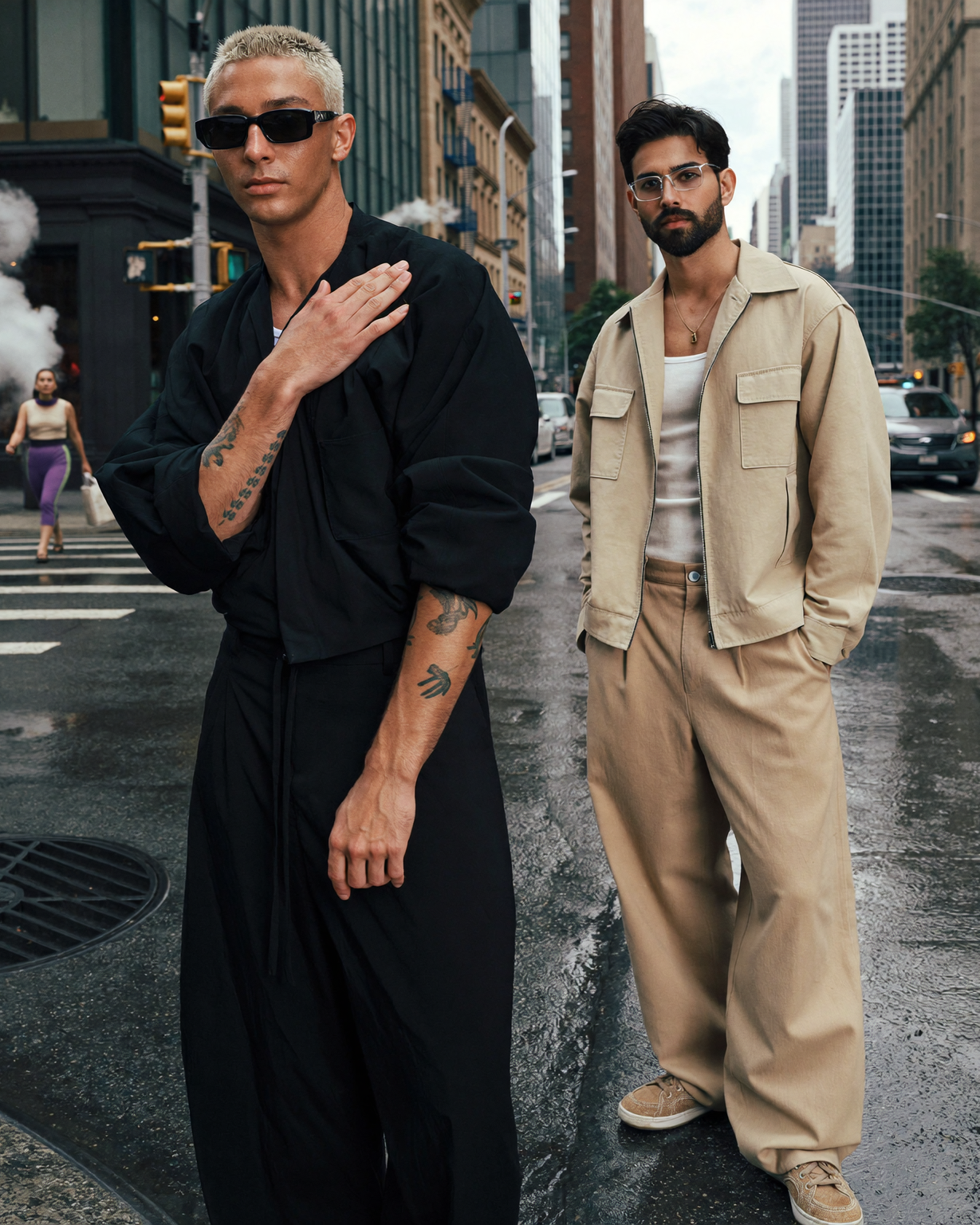
There is a reason angular black zip blazer works with wide grey denim: the pieces have very different proportions, so neither gets lost. Keep plain lightweight tee in the middle to connect them visually. This is the kind of outfit that looks styled but still lets you go about your day. No dramatic choreography required, and definitely no fifteen-minute adjustment routine before leaving.
The lower half is the next decision. wide grey denim supports this outfit because strong shoulder keeps roomy denim balanced. Let the trousers hang naturally before judging the length: you want the waistband to sit where you actually wear it, and you want enough space to walk instead of constantly yanking fabric back into place. If the jacket finishes at the upper hip, check where the trouser shape begins; that meeting point controls the whole silhouette more than an extra necklace ever will.
Now the shoes: I would reach for lace-up black boots. The hem should meet the shoe in a controlled way instead of swallowing the entire foot. Take a few steps and see whether the fabric catches or trails; that matters far more than a perfectly motionless mirror shot. You want the footwear to anchor the proportions without introducing a competing style story.
There is no need to make the color palette complicated. Stick with monochrome shades of black and faded grey and pay attention to what the materials do when you move. Brushed texture catches soft light; washed denim creates irregular grey; smoother outerwear defines the shoulder or waist more sharply. Those differences are the visual interest. IMO, this beats adding a random statement color simply because you feel obligated to break up the black.
Now picture wearing it for city stroll and café stop. Will the outfit handle walking, sitting, carrying a bag and taking the jacket off once you go indoors? That everyday test matters, because clothes lose a lot of their charm when you spend the whole day adjusting them. In particular, carry blazer over arm comfortably when indoors. A garment that makes you feel restricted while standing still will not become more comfortable because the photograph has dramatic lighting.
One thing I would skip is bulky sweatshirt under tight armhole. It sounds small, but it can turn an otherwise excellent combination into too many competing gestures. Look at the collar, waist and shoe before adding jewelry or a bag; if those three areas already have texture, let an accessory be quiet. A black crossbody or simple belt is often more useful than a dramatic piece that pulls the eye away from the jacket and the way the trousers fall.
For a purchasable starting point, see Niche Padded Shoulder Zip Blazer. This is a real OFFCULTURE catalog item, though the full look includes styling suggestions that are not necessarily bundled or sold as a set. Review its current sizes, colorway and care details on the actual product page before buying; material names in fashion marketing are not always literal fiber descriptions. The practical alternate is to use fine cardigan instead of tee. That leaves the mood intact while making the outfit easier to repeat on another day.
3. Warm-Toned Blazer + Black Knit

Want a little more intention without looking overdressed? Put red tailored blazer as statement layer next to relaxed charcoal trousers and work light black crewneck into the gap. The overall effect comes from contrasting the weight of the outer layer and the way the bottoms move. You can wear the same pieces in several combinations, but this one gives them a particularly good reason to be together.
The lower half is the next decision. relaxed charcoal trousers supports this outfit because one color accent energizes fall neutrals. Let the trousers hang naturally before judging the length: you want the waistband to sit where you actually wear it, and you want enough space to walk instead of constantly yanking fabric back into place. If the jacket finishes at the upper hip, check where the trouser shape begins; that meeting point controls the whole silhouette more than an extra necklace ever will.
Here is where flat black ankle boots makes a real difference. The shoe adds an ending to the leg and prevents the whole outfit from feeling like one long piece of fabric. Before you decide the trousers are too wide or too narrow, check them with the shoes you intend to wear. That one swap often fixes the balance faster than changing the jacket.
For color, keep the story close to dark red, black and charcoal. The interesting differences come from matte versus coated, faded versus solid, and the way light settles on each surface. I would avoid forcing every black to match perfectly; they rarely do, and the variation can actually make the outfit richer. Step into natural light to see whether the jacket and trousers still read as separate shapes.
Now picture wearing it for evening dinner. Will the outfit handle walking, sitting, carrying a bag and taking the jacket off once you go indoors? That everyday test matters, because clothes lose a lot of their charm when you spend the whole day adjusting them. In particular, check the blazer is comfortable with sleeves fully extended. A garment that makes you feel restricted while standing still will not become more comfortable because the photograph has dramatic lighting.
One thing I would skip is adding a bulky scarf over sharp lapels. It sounds small, but it can turn an otherwise excellent combination into too many competing gestures. Look at the collar, waist and shoe before adding jewelry or a bag; if those three areas already have texture, let an accessory be quiet. A black crossbody or simple belt is often more useful than a dramatic piece that pulls the eye away from the jacket and the way the trousers fall.
For a purchasable starting point, see Xculture Luxury Red Elegant Blazer. This is a real OFFCULTURE catalog item, though the full look includes styling suggestions that are not necessarily bundled or sold as a set. Review its current sizes, colorway and care details on the actual product page before buying; material names in fashion marketing are not always literal fiber descriptions. The practical alternate is to wear all black underneath when unsure. That leaves the mood intact while making the outfit easier to repeat on another day.
4. Relaxed Blazer + Open Cardigan + Denim

The best thing about roomy blazer with extended shoulder is how much personality it carries without shouting. With dark washed straight jeans and thin button cardigan, that personality has somewhere to land. You are not stacking statement pieces for the sake of it; you are designing one readable shape. That distinction matters when you want something interesting enough for photographs and comfortable enough for normal life.
The lower half is the next decision. dark washed straight jeans supports this outfit because two slim layers under one relaxed outer piece. Let the trousers hang naturally before judging the length: you want the waistband to sit where you actually wear it, and you want enough space to walk instead of constantly yanking fabric back into place. If the jacket finishes at the upper hip, check where the trouser shape begins; that meeting point controls the whole silhouette more than an extra necklace ever will.
Put on low-profile leather-look boots before making your final call. Wide and relaxed trousers respond differently to a sharp toe than to a round heavy sole, and a good break at the hem makes the difference visible. If you spend the day stepping on your jeans, the outfit is not working, however spectacular it looked in a single photograph. Adjust the length before blaming the silhouette.
The palette here is charcoal, cream and faded black, but that does not mean every piece should have the same finish. A washed fabric absorbs light differently from a coated one, and a ribbed knit breaks up smoother material without requiring another color. That visual separation is what keeps the outfit from falling flat. If everything feels too busy, edit the accessories rather than adding another bright element.
Now picture wearing it for library-to-studio afternoon. Will the outfit handle walking, sitting, carrying a bag and taking the jacket off once you go indoors? That everyday test matters, because clothes lose a lot of their charm when you spend the whole day adjusting them. In particular, make sure cardigan placket lies flat. A garment that makes you feel restricted while standing still will not become more comfortable because the photograph has dramatic lighting.
One thing I would skip is three thick fabrics fighting at the button closure. It sounds small, but it can turn an otherwise excellent combination into too many competing gestures. Look at the collar, waist and shoe before adding jewelry or a bag; if those three areas already have texture, let an accessory be quiet. A black crossbody or simple belt is often more useful than a dramatic piece that pulls the eye away from the jacket and the way the trousers fall.
For a purchasable starting point, see Script-X Wool Wrap Cardigan. This is a real OFFCULTURE catalog item, though the full look includes styling suggestions that are not necessarily bundled or sold as a set. Review its current sizes, colorway and care details on the actual product page before buying; material names in fashion marketing are not always literal fiber descriptions. The practical alternate is to remove cardigan as temperatures rise. That leaves the mood intact while making the outfit easier to repeat on another day.
5. Structured Blazer + Long Tee + Dark Cargo

There is a very specific kind of confidence in pairing modern tailored blazer with black barrel cargo jeans. The first piece sets the mood and the second gives it movement. Bring in lightweight long-sleeve tee as the connection and resist the temptation to make every detail equally loud. The look is stronger when a few elements get to lead and the rest just do their jobs.
The lower half is the next decision. black barrel cargo jeans supports this outfit because jacket structure balances utility details at hip. Let the trousers hang naturally before judging the length: you want the waistband to sit where you actually wear it, and you want enough space to walk instead of constantly yanking fabric back into place. If the jacket finishes at the upper hip, check where the trouser shape begins; that meeting point controls the whole silhouette more than an extra necklace ever will.
The footwear I would choose here is sturdy black boots. It gives the bottom half its own point of definition while letting the garment above stay expressive. Make sure the outsole is suitable for where you are going and the trousers move freely over it. A clean profile at the ankle often does more for a roomy outfit than another belt, chain or bag.
Build around black, grey and muted white at neck and give yourself permission to mix surfaces. One garment can shine while another stays deliberately dull; that is a more modern kind of coordination than getting every fabric to match a paint chip. Check the outfit in daylight, not only under a yellow bedroom lamp. Texture does the storytelling here, and the color palette simply keeps it all in the same conversation.
Now picture wearing it for evening art show. Will the outfit handle walking, sitting, carrying a bag and taking the jacket off once you go indoors? That everyday test matters, because clothes lose a lot of their charm when you spend the whole day adjusting them. In particular, check trouser pockets sit below blazer hem. A garment that makes you feel restricted while standing still will not become more comfortable because the photograph has dramatic lighting.
One thing I would skip is trying to match every cargo detail with blazer hardware. It sounds small, but it can turn an otherwise excellent combination into too many competing gestures. Look at the collar, waist and shoe before adding jewelry or a bag; if those three areas already have texture, let an accessory be quiet. A black crossbody or simple belt is often more useful than a dramatic piece that pulls the eye away from the jacket and the way the trousers fall.
For a purchasable starting point, see Vintage Arc Cargo Jeans. This is a real OFFCULTURE catalog item, though the full look includes styling suggestions that are not necessarily bundled or sold as a set. Review its current sizes, colorway and care details on the actual product page before buying; material names in fashion marketing are not always literal fiber descriptions. The practical alternate is to swap cargo jeans for soft straight trousers. That leaves the mood intact while making the outfit easier to repeat on another day.
What to check before you buy the look
A good fall layer must come off easily
A lightweight cardigan or fine turtleneck under a blazer works because you can adjust throughout the day. If every layer has a bulky cuff, tall collar and heavy hem, you get friction instead of versatility. Choose one piece to create interest and keep the others smooth enough to slide over one another. A blazer should remain useful when you take the knit off, which is why the tee-and-jeans foundation is worth making attractive on its own.
Think about evening transitions
Choose a shoe that works for the longest part of your day and make one small switch at night. Boots can dress up washed denim, while a darker knit under the blazer makes a simple outfit feel more deliberate. If the weather changes, carry a separate coat rather than expecting lightweight tailoring to handle heavy wind. The goal is a wardrobe that behaves naturally, not a perfectly composed photograph that stops working as soon as the temperature moves.
Quick questions, answered
What can I layer beneath a blazer in fall?
Fine turtlenecks, plain tees and lightweight cardigans work when the shoulder and sleeve fit allows them.
Can a blazer replace a fall coat?
On some mild days it may be enough, but lightweight tailoring is not a guaranteed weather-protective layer in cold rain or strong wind.
How do I make a blazer look less formal?
Start with relaxed denim or cargo trousers, a plain tee and shoes that suit everyday movement rather than a matching suit.
The takeaway from these fall blazer outfits? Keep the garment you love at the center, then give it enough space to look good. A working combination should survive the real world: a long walk, the first cold evening, a warm café, an unexpected change of plans. Save the look whose proportions and practical details suit you best, and repeat it with pieces you already own. Explore the linked OFFCULTURE pieces when you want to find the shape, texture or finishing detail that makes the next version feel like yours.
Leer más

An oversized sweater and baggy jeans are the easiest outfit to love in theory and one of the easiest to lose yourself in when every hem decides to head south. You do not need to abandon the volume....

An all-black outfit does not need a new color to become interesting. It needs materials that react differently to the light, shapes that do not collapse into each other and one intentional focal po...