
Men's Fall Streetwear Outfits With Baggy Denim
The Line Between Roomy and Unconsidered
Baggy denim changes the emotional temperature of an outfit. It can make a blazer look less ceremonious, a bomber less predictable, even a familiar tee feel like a deliberate choice. But looseness is not a styling solution by itself. The difference between ease and excess often comes down to a few quiet decisions: where a jacket ends, whether a shoulder can move without sliding, and how much jean hem gathers above a shoe. Fall streetwear works when those decisions feel considered without making the clothes look overmanaged.
The five outfits here approach that problem from different angles. One uses the doubled presence of denim, another lets an earthy bomber soften a black hoodie, and a third contrasts a boxy overshirt with a cleaner base. Later, a blazer lends the jeans some structure, while a cropped jacket and boots make the ankle the point of balance. None is a fixed uniform. Each is a useful way to think about volume, and each can be translated with pieces already in a wardrobe.
Five Ways to Build the Outfit
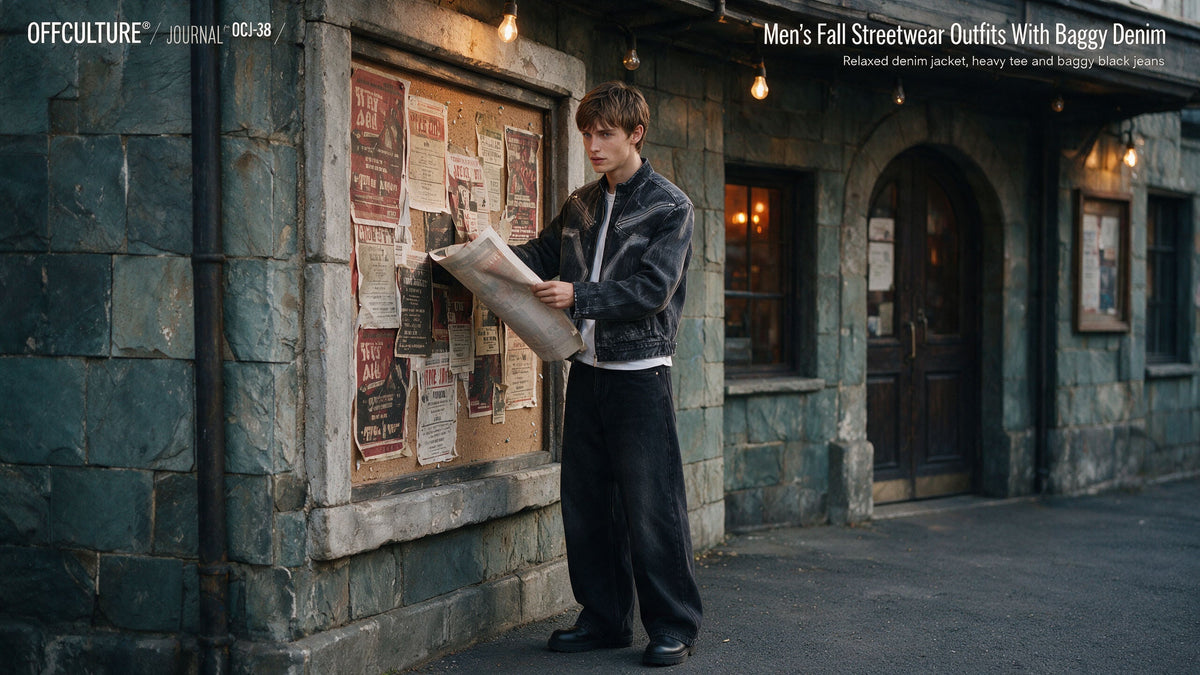
1. Relaxed denim jacket, heavy tee and baggy black jeans
The appeal of this combination is its near-familiarity. A denim jacket and jeans can look like a matching set even when the washes are different, so black trousers provide a useful interruption. The jacket supplies the visible denim character; the black jeans give the lower half a quieter field. If you are choosing your own pieces, compare the shades and surface treatments rather than trying to match them exactly. Two close but not identical blues can look accidental. A clear contrast, as here, gives the eye a reason to read the jacket and trousers separately.
A heavy tee is a convincing middle ground because it can hold its own beneath a relaxed jacket without adding a second collar or a hood that crowds the neckline. Check the jacket with the tee you intend to wear, not over a thin fitting-room layer. The shoulder seam should sit in a place that lets you lift your arms, and the body should close without pulling across the chest. Worn open, the jacket frames the tee and creates a vertical line through the torso. Closed, it becomes a stronger block of denim. Neither is automatically better; the open version is usually easier when the tee is long, while a closed jacket can work if its hem does not collide with the jeans’ rise.
The trousers need enough room through the seat and thigh to make the word baggy mean comfort, not merely a wide ankle. Sit down and check that the waistband stays settled. Then look at the hem with the shoes you will actually wear. A small break gives the leg a destination; substantial pooling can swallow the shoe and drag visual weight to the floor. If you want to compare a wide-leg cut, these denim options are a starting point for examining shape and measurements, not a claim that the photographed outfit is sold as a set.
Keep accessories secondary. The outfit already has a strong workwear vocabulary in the jacket, tee and denim, so a small bag or restrained belt is more useful than stacking on extra visual statements. The successful version feels as if its wearer can move through a normal day: jacket open on a warmer walk, closed when the air cools, black jeans still easy to pair tomorrow. That ordinary usefulness is part of the style, not a compromise with it.

2. Brown bomber, black hoodie and faded wide denim
A brown bomber changes the mood of a black hoodie without asking the outfit to become colorful. The brown reads warmer against the black, while faded wide denim introduces a third value below them. That arrangement matters: if the jeans are very pale, the upper half can feel top-heavy; if they are dark, the distinction between hoodie and trousers may flatten. Look at the outfit in daylight as well as indoors, because the relationship between black, brown and faded blue can shift noticeably with the light.
The hoodie is the layer most likely to create a fit problem. Its hood and shoulders need enough room beneath the bomber, but excess fabric gathering at the neck can make the head and upper chest look crowded. Try the bomber over the hoodie with the hood resting naturally, then raise your arms and reach forward. The jacket should not ride up so far that the hem stays bunched when you lower them. Sleeve length deserves the same attention: a cuff that catches on the hoodie sleeve becomes irritating long before it becomes visible in a photograph. A simple tee hem beneath the hoodie can add another line, but if several layers collect at the waist, shorten or remove one rather than tugging at all of them all day.
Here the generous jean leg does much of the silhouette work. That width can balance a roomy upper half, but the bomber should still have a readable endpoint. If both jacket and trousers are long, the outfit risks becoming one broad column with no pause. The bomber’s hem provides that pause; keep it visible rather than letting the hoodie hang far below it by accident. This is a proportion choice, not a rule that every layer must be cropped. A longer hoodie can work if the jacket is worn open and the length looks deliberate.

3. Boxy overshirt, ribbed tank and loose grey jeans
This is the most stripped-back outfit of the five, which makes its proportions unusually easy to read. A boxy overshirt gives the shoulders and torso a defined outer shape; the ribbed tank keeps the center line simple. Loose grey jeans bring volume below without repeating the color of a blue denim jacket or asking for another strong layer. Grey also makes room for small differences in tone. The outfit can stay quiet without becoming blank, especially when the overshirt and jeans do not match precisely.
A tank is not merely a warmer-weather substitute for a tee here. It removes fabric at the neckline and sleeves, so the overshirt’s collar, shoulder and opening become more visible. That can feel clean and comfortable indoors, though the outfit may need a different base layer outdoors as temperatures change. Try the overshirt over the actual layer you expect to wear. If it is too narrow at the back or pulls across the upper arm, sizing up may not fix the problem if the body then hangs too long. Pay attention to the shoulder seam and arm movement first, then judge the hem. A boxy cut should have space, but the wearer should not have to keep repositioning it.
The overshirt can be worn open to give the tank a narrow frame or buttoned to create a more continuous block. Open, it lengthens the torso visually, which can be helpful if the jeans sit high or have a broad waistband. Buttoned, it makes the top half more self-contained and gives the loose trousers greater visual emphasis. Check how the hem meets the jeans in both positions. If the overshirt ends exactly where the widest part of the hip begins, a small change in length can make the outfit feel more balanced. The answer is not necessarily a shorter shirt; sometimes leaving it open creates the separation you want.
Grey denim rewards attention to texture because the color is restrained. A visibly faded surface can play against the ribs of the tank or the overshirt’s cleaner planes without an added accent. Keep accessories modest enough to preserve that conversation. For shoes, avoid making the jeans do all the work of hiding a pair that feels too slight. A shoe with enough substance to register beneath the loose hem helps the silhouette feel grounded. This is a good transitional outfit when plans change from afternoon to evening: add a practical outer layer for the walk, then remove it without leaving a complicated stack of clothes underneath.

4. Black blazer, vintage tee and baggy blue jeans
The blazer introduces a change in posture. Not a demand to stand stiffly, but a suggestion of definition through the shoulder and lapel. Against a vintage tee and baggy blue jeans, that structure makes the casual pieces look chosen rather than simply assembled. The contrast is the point: the jeans carry ease, the tee brings an informal graphic or aged quality if its design has one, and the blazer sets a cleaner frame around both. The photo’s description does not specify a particular tee graphic, so choose one whose color and scale sit comfortably beneath the lapels rather than competing with them.
Fit is less forgiving in a blazer than in an overshirt. The shoulder should sit smoothly over the tee, not droop far past the natural shoulder or pull tight when you move. Check that the lapels rest close to the chest instead of springing outward, and that the blazer can be worn open without its fronts flaring awkwardly. You do not need a narrow jacket to wear wide jeans. In fact, a little ease through the body can make the pairing more credible. But if the jacket is very long and the jeans are also long and broad, the outfit may lose its point of division. Look at where the blazer ends in relation to the waistband and the fullest part of the seat.
The tee is the bridge between tailoring and denim. A collar that lies flat and a neckline that has not become stretched out help the blazer look intentional, while a little visual age can keep the outfit from seeming office-bound. If the tee is long, tuck it lightly or choose a shorter one so it does not emerge in a narrow strip below the blazer. A full tuck may feel too formal beside baggy jeans; a clean hem can be more natural. Try sitting in the jacket before deciding. The back should not pull sharply, and the sleeves should remain comfortable when you reach forward.

5. Cropped zip jacket, straight baggy jeans and boots
This outfit makes the ankle and waistline do more of the balancing. A cropped zip jacket gives the torso a shorter endpoint, while straight baggy jeans continue downward with room rather than narrowing sharply. Boots provide a visible base beneath the hem. The result is not a skinny-jean silhouette scaled up, and it should not be styled as one. The straight leg needs enough space to fall cleanly over the boot, with no constriction at the calf that makes the fabric kick outward or catch above the shoe.
The jacket’s cropped length can make the legs look longer, but only if the jeans sit at a rise that feels comfortable and the jacket does not expose more than you want when you reach or bend. Zip it, leave it open, then sit and raise your arms. That simple test shows whether the hem remains where you expect it to. A jacket that feels cropped in a product photo may land differently on a taller or shorter body, so compare garment measurements with a jacket you already like. Check sleeve length too: a compact body with sleeves that stop too high can make the whole piece feel undersized rather than intentionally short.
The jeans should provide the room the outfit promises. Make sure pockets remain usable and the waistband does not need constant adjustment, especially when the jacket is open and the waist becomes more visible. At the hem, aim for a clean relationship with the boots. A slight break can soften the line; fabric stacked in several thick folds can make the boot disappear and undermine the deliberate crop above. If the jeans are long, hemming them is a practical fix that often improves more than one outfit. If you prefer to keep the original length, consider whether a different boot height or shape lets the hem fall more naturally.
Keep the rest of the outfit measured. A belt, if visible, can connect jacket and jeans, but there is no need to add extra hardware simply because the silhouette has strong lines. The boot is already doing useful work as a grounded endpoint. This combination suits days when you want a clear, compact upper half and the comfort of space through the leg. It also adapts well to changing plans: the jacket can come off without leaving an elaborate set of layers, while the jeans and boots remain a coherent foundation. The strongest version is not the most dramatic one. It is the one in which every edge, from zip to cuff, has room to do its job.

Proportion Is Something You Test, Not Guess
Baggy denim is often described as if width were the only measurement that mattered. In practice, the cut through the seat, thigh and knee shapes how a pair feels and hangs. Two jeans with similar leg openings can behave differently because one has more room higher up or a different rise. That is why a size label tells only part of the story. Compare measurements with a pair you already wear comfortably, especially the waist, rise, thigh and inseam. If online details are available, use them before treating a model photograph as a fit promise.
Upper-body length matters just as much. Put a cropped jacket with a long tee, and the exposed strip below the jacket can either create a useful layer or interrupt the line. A long blazer over a very wide jean can feel enveloping, while a shorter outer layer may restore definition. These are relationships, not formulas. A person with a longer torso may want a different jacket endpoint from someone with shorter proportions. Instead of memorizing a preferred ratio, check where the top ends relative to the waistband, hip and fullest part of the trouser. A mirror from the side is particularly useful here.
Comfort, Weather and the Clothes You Actually Wear
Streetwear is often photographed standing still, but the clothes are lived in while carrying a bag, entering a heated room, sitting on transit or walking farther than expected. Test layered outfits in those ordinary conditions. Reach forward in a jacket, turn your shoulders, sit with the waistband fastened and check whether the hem stays comfortable. A hoodie beneath a bomber needs room at the neck and upper back. A blazer should not restrict the tee wearer from moving naturally. If the outfit works only with arms held close to the body, it is not a good fit for daily use.
Fall dressing is a sequence of changing environments, not simply a choice between “light” and “warm.” A tank beneath an overshirt can be comfortable in one setting and insufficient in another. A heavy tee may be enough indoors but not outside for a long wait. Plan layers you can remove without leaving the remaining outfit unresolved. The visible appearance of a jacket or the weight implied by a photograph does not prove its insulation, construction or weather resistance. Check garment information and make decisions based on the real conditions, rather than asking styling to stand in for practical clothing.
Texture also deserves a practical role. Faded denim carries more visual detail than a very dark, even wash; a ribbed base has a different surface from a plain tee; a blazer introduces cleaner lines. Choose one or two surfaces to lead. If every garment has a strong wash, graphic or pronounced texture, the eye has nowhere to settle. Conversely, an all-dark outfit can benefit from the distinction between black jeans, a black tee and a jacket with a different shape. Contrast need not mean color. It can come from length, finish, collar, lapel or the space between layers.
Choosing Pieces That Earn Their Place
When shopping, start with the garment that is hardest to substitute. For one person that may be a comfortable, well-proportioned pair of wide jeans; for another, it may be a jacket with a shoulder that fits properly over the layers they already own. Read measurements and care details, and compare them with clothes in your wardrobe. A category name such as “relaxed,” “wide” or “oversized” cannot tell you where a hem will land on your body. Product images are helpful, but they are not a substitute for garment dimensions or trying the piece with your own shoes.
You can shop OFFCULTURE® streetwear for pieces to consider alongside these combinations, then browse compatible separates to compare lower-half options. Those are places to explore individual garments, not evidence that the five photographed looks are exact products or packaged outfits. For the denim in particular, use the buttoned wide-leg jeans listing to inspect the available product details and decide whether its cut suits your proportions. If it does not, use the same fit questions to find a different pair: room through the seat, a comfortable rise and a hem that works with your shoes.
A good purchase should make more than one outfit easier. A relaxed jacket that layers over a tee and a hoodie has greater wardrobe use than a piece that works only over a single thin top. Jeans that sit well with boots and sneakers are more flexible than a pair whose hem requires one particular shoe. Before buying, imagine at least three existing combinations. If you cannot picture the garment without also buying several supporting pieces, pause. That is not a prohibition on building a new look; it is a way to distinguish a useful addition from a brief styling impulse.
Questions About Men’s Fall Streetwear With Baggy Denim
What should I choose first: the jeans or the jacket?
Choose whichever piece will determine the proportions you find hardest to adjust. If you already own a jacket whose shoulder and length work, finding jeans that sit well beneath it is straightforward. If the trousers are the anchor, bring attention to their rise, thigh and hem, then select an outer layer that ends at a complementary point. Either way, try the actual pieces together. A jacket that looks right over narrow trousers online may feel very different above a wide leg, and a visually appealing jean can become inconvenient if its hem catches on your regular shoes.
How baggy should men’s fall jeans be?
Baggy should describe the amount of ease you want, not an obligation to buy the widest option. Start with comfort through the seat and thigh, then look at how the leg falls from knee to hem. You should be able to sit, walk and use the pockets without pulling at the waistband or fabric. A wide opening can work, but the full outline needs to suit your shoes and the rest of the outfit. If the top half is already broad, consider a cleaner jacket length or a more defined shoulder rather than automatically reducing the jeans’ width.
How do I keep long jeans from looking messy?
Try the jeans with the shoes you wear most often and inspect the hem while standing and walking. A slight break or a controlled stack can look relaxed; several heavy folds that conceal the shoe may look accidental and can be uncomfortable. If the cut otherwise works, hemming is often a more reliable answer than changing the whole outfit. Ask a tailor how the original hem can be handled if preserving the finish matters to you. Avoid deciding from a seated photograph, since fabric gathers differently once you stand and move.
Can I wear baggy denim with a blazer?
Yes. The useful contrast is between the blazer’s defined shoulder and the jeans’ ease, with a tee making the transition feel natural. Check that the blazer fits smoothly over the actual base layer, that the lapels lie flat and that its length does not overwhelm the trousers. A vintage tee can loosen the formality, but its hem should not bunch below the jacket. Shoes should make sense with both pieces. The outfit works best when the blazer feels like part of the day rather than an office garment borrowed to make casual clothes look smarter.
What should I change when fall temperatures shift?
Adjust the layer closest to your body or add an outer layer you can remove, rather than treating the photographed combination as fixed. A tank and overshirt, for example, can be adapted with a tee or another layer beneath the overshirt, provided the fit still allows movement. A hoodie beneath a bomber requires room through the shoulders and sleeves. Check product information for practical properties and dress for actual conditions. Appearance alone cannot establish whether any garment is warm enough or suited to rain.
Keep the Wardrobe in Conversation
These outfits become more useful when treated as questions rather than templates. What changes if a long tee is replaced by a shorter one? Does the bomber work better open or zipped? Which shoe lets the hem fall cleanly? Testing those small choices helps identify the piece that is carrying the outfit, and the one that is merely occupying space. For further ways to judge volume and everyday combinations, read our trouser and denim guide and the streetwear silhouette guide. Both offer broader ways to think about cut, season and wardrobe use without turning one photograph into a rulebook.
The most convincing fall outfit is rarely the one with the most pieces. It is the one that lets the wearer forget about adjusting them. A jacket stays where it should, the jeans clear the shoes, and the layers still make sense when the weather or the plan changes. Baggy denim brings room into the picture. Good styling gives that room direction, then leaves enough ease for a real day to happen inside it.
Read more

Winter layers work with baggy pants when warmth does not bury the shape. Five combinations pair roomy bottoms with compact puffers, boxy bombers or a long coat, using hoodies, knits and thermals un...

A blazer looks different when the trousers stop behaving like office clothes. From charcoal coat, black blazer, thin rollneck and straight trousers to belted long coat, slim blazer and straight boo...