

Winter Jacket Outfits for Men Beyond the Puffer
Winter dressing is often treated as a contest against the weather, but it is also a negotiation with the mirror: how much room can a body take up before the clothes begin to wear the person? A puffer solves one problem by making its answer visible. The alternatives here are less declarative. They depend on where a jacket stops, what kind of space a trouser leg leaves around the shoe, and whether the layer beneath still looks like a garment when the coat comes off.
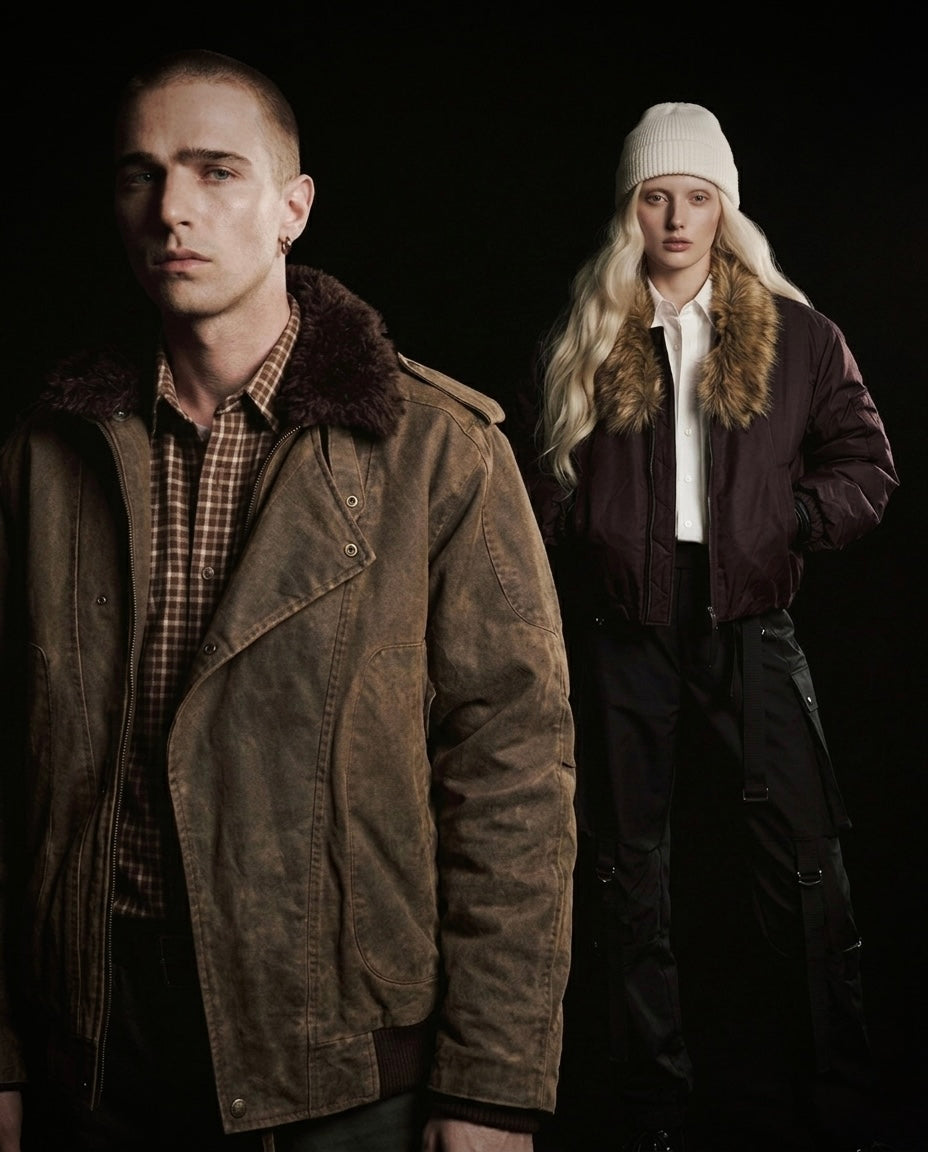
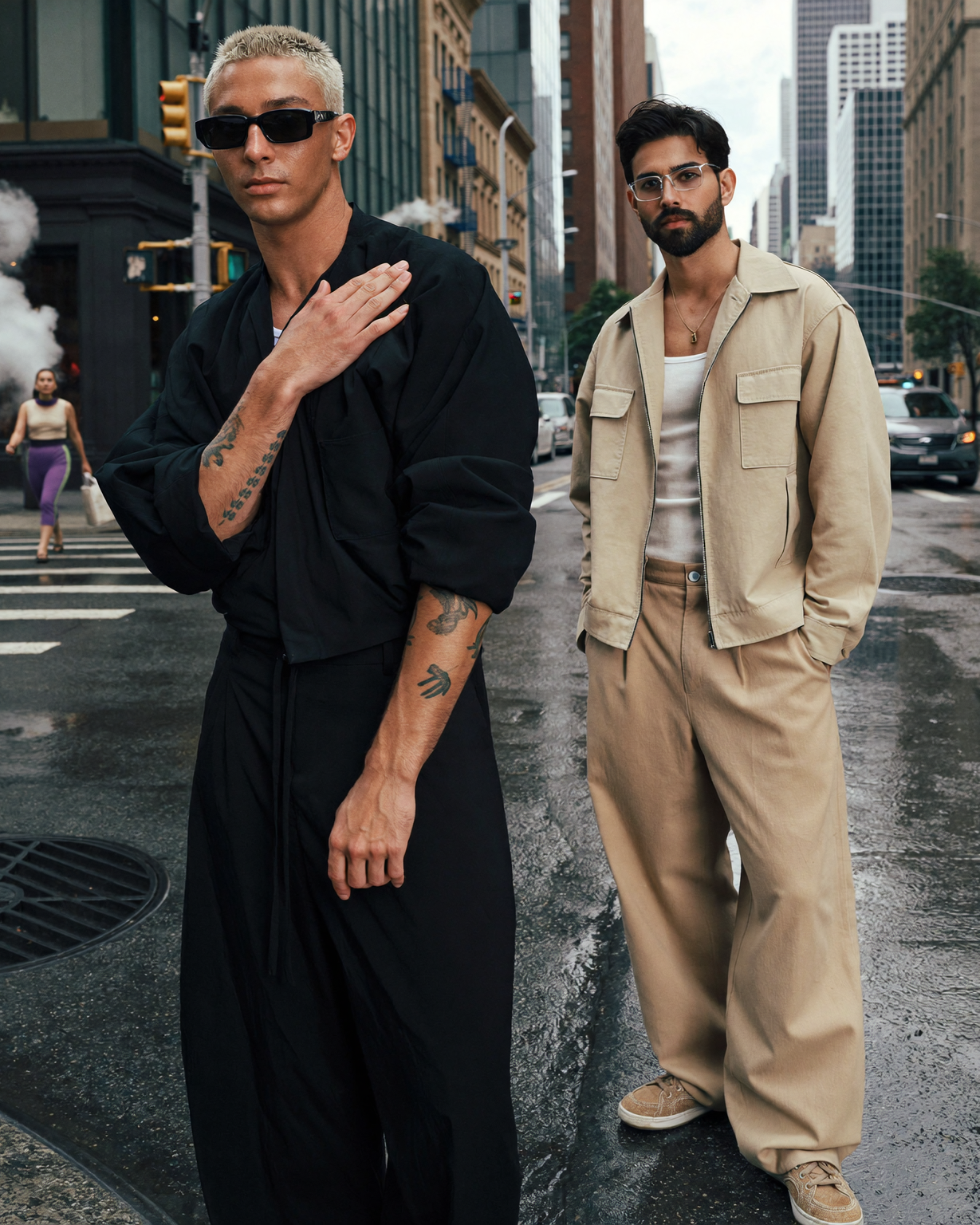
That is the useful territory beyond the puffer. Not a ban on practical clothes, and not a claim that a wool-look jacket or a leather-look surface can do the same work as purpose-built insulation. These are five ways to think through the outline of a winter outfit: a structured jacket with a close neck and dark denim; denim tucked under a practical coat; a cropped biker shape balanced by relaxed trousers; a long bomber-style coat with pleated trousers; and a roomy utility jacket with cargos. Each puts the emphasis somewhere different.
The photographs offer silhouettes, not prescriptions. A reference image cannot tell you how a sleeve feels when you reach for a train rail, whether a collar sits comfortably against your neck, or what the garment can handle in actual weather. Those are questions to answer with the clothes themselves. What the image can show is proportion: where visual weight gathers, how one length meets another, and which part of the outfit is allowed to speak first.
The quiet authority of a short, structured jacket

The first look is built on restraint: a structured wool-look jacket, a mock neck and dark jeans. Its strength is not a dramatic contrast but a close arrangement of shapes. The jacket gives the upper body a defined edge; the mock neck continues that line without introducing another collar; the dark denim keeps the lower half from pulling attention away. It is a compact outfit, but not necessarily a tight one. The distinction matters. Structure comes from the garment’s outline, while ease comes from having enough room to move inside it.
A shorter jacket can make the body seem more deliberately divided. Its hem draws attention to the trouser rise, so the jeans need to feel chosen rather than merely convenient. A mid- or higher-rise pair can connect naturally to the jacket’s lower edge. With a low rise, the visible break between jacket and waistband may feel abrupt, particularly if the jacket is worn open. Try both positions in a mirror, then sit down. A hem that looks precise while standing can bunch or ride up once the body moves.
The mock neck is doing a quiet amount of work. It gives the center of the outfit a clean vertical line, which is why a second bulky collar can make the area feel over-managed. If you need a scarf, choose one that can lie without crowding the neckline, or let the scarf replace the mock neck rather than compete with it. There is no virtue in keeping every detail visible. A winter outfit often looks more convincing when one practical choice is allowed to disappear into the whole.
Dark jeans make this combination adaptable, but they also invite a little scrutiny of the shoe. A narrow or very delicate shoe can make a structured jacket seem heavier than intended; an oversized shoe can overwhelm the clean line below the hem. Look at the jeans’ break while standing naturally. A slight rest on the shoe reads differently from a stack of fabric at the ankle, and the difference becomes more apparent when the jacket is short. If the jeans are loose, keep the hem tidy enough that the leg retains its shape.
This is the look for someone who wants winter clothes to feel composed without looking formal. It can go to a music venue, a late dinner or an ordinary day when a hoodie feels too familiar. Keep accessories secondary. A belt, bag or visible jewelry can add character, but piling several focal points onto a compact silhouette blurs its clarity. The jacket already has a job: framing the torso. Let the denim and shoes finish the sentence.
A second layer should not erase the first

The denim jacket beneath a practical coat changes the question from “which jacket?” to “which layer needs to fit closest?” The denim is the visible personality of the outfit, while the outer coat supplies a longer, more neutral frame. Straight trousers keep the lower half legible. This is less about stacking as many garments as possible than deciding which layer is allowed to show. If the denim collar, front and hem vanish entirely beneath the coat, it may as well have stayed at home.
Start with the shoulders. Both jackets need to sit correctly when worn alone, but the outer coat must also accommodate the denim without pulling across the back or restricting the arms. Do not size the entire outfit by the label on either piece. Put the layers on together and reach forward, cross your arms, lift them overhead, then sit. A coat that hangs well in a still photograph may draw tight at the shoulder blades once a second layer is underneath. A little extra room can be useful; excess width that collapses the coat’s line is a different matter.
The denim collar is firm and visually distinct. A smooth inner neckline can help it sit cleanly, while a thick hood trapped underneath may crowd the back of the neck. There is no need to ban hoodies from the equation, but notice where the fabric collects. If the collar is being pushed up and outward, the layers are competing for the same space. Try a simpler knit or top, or leave the inner layer open if the garments allow it. The answer is not always another size.
Straight trousers are a sensible counterweight to the layered torso because they do not introduce a second strong flare or a large pocketed volume. Check their length with the shoes you actually plan to wear. A clean break makes the outline feel intentional; a hem that drags or stacks heavily can make the outfit appear bottom-heavy, especially if the coat extends well below the waist. If the trousers are too long, changing the hem is often more effective than adding a conspicuous accessory to distract from it.
This combination also has a useful wardrobe logic: each piece can remain meaningful when the weather or setting changes. The denim jacket can work on its own; the practical coat can sit over other clothes. That does not guarantee the outfit is warm or protective enough for a particular day. Check the garments’ actual details and your conditions. As styling, though, the arrangement avoids the feeling of a single sealed costume. You can remove a layer without losing the outfit’s point.
The cropped jacket earns its space

A cropped biker-style jacket, scarf and relaxed pants is the most openly dependent on proportion. The jacket ends high; the trousers take up more room; the scarf introduces a soft vertical element near the face. The appeal comes from those separate decisions meeting without being smoothed into one continuous column. The risk is equally clear: if the jacket is too short for the rise of the trousers, or the trousers are so wide that they swallow the shoes, the look can seem assembled from unrelated pieces.
Begin with the waistband. A cropped jacket makes it visible, so the rise and fit of the pants matter more than they might beneath a longer coat. The waistband should sit where you want the silhouette to divide, not wherever an old pair happens to land. If the trousers are relaxed through the leg, a secure waist gives that volume a point of origin. A jacket that finishes near the waistband can look balanced; one that finishes far above it may expose a strip of shirt or knit in a way you did not intend. Try the outfit with the jacket closed and open, since the opening changes how much of the inner layer becomes part of the silhouette.
The scarf is not merely a cold-weather add-on here. It softens the hard-edged suggestion of a biker shape and gives the eye somewhere to travel between the cropped hem and the wider trousers. But a very thick scarf can crowd a short jacket’s upper half, especially if its collar already stands away from the neck. A narrower drape or a less bulky wrap can preserve the same contrast without making the shoulders appear compressed. If the outfit feels busy, take the scarf away before changing the pants. It may be the most adjustable element.
The source of the jacket’s surface should not be assumed from its appearance. A leather-look finish can sit sharply against a matte knit or faded denim, but visual resemblance does not establish a garment’s composition or its performance in weather. Treat the combination as a styling idea, then inspect the actual garment details before deciding what it can do outdoors. In cold or wet conditions, a cropped shape may also leave more of the body exposed than a longer coat. That is a real tradeoff, not a failure of styling. Add suitable layers or reserve the outfit for conditions in which it is comfortable.
Relaxed pants need a deliberate relationship with footwear. Too much fabric pooled at the ankle blunts the jacket’s clean crop; a controlled break lets the trouser remain generous without looking careless. Try the pants with the shoes you wear most, not just the pair that looks best in a photograph. This silhouette rewards a little contrast, but it still needs continuity: a repeat of one color between top and bottom, or a quieter inner layer, can make the individual shapes feel like a considered outfit.
Let the coat keep its long line

The long bomber-style coat, pleated trousers and boots make a different kind of argument. Where the cropped biker jacket announces the waist, this coat delays it. Its long vertical line takes up visual space, and the pleats bring a controlled fullness below. Boots give the lower edge a firm destination. The result can feel imposing in the best sense, but it asks for attention to the point where coat and trouser meet.
Pleated trousers need room to fall from the waistband. If a long top layer covers the pleats completely, the detail that gives the trousers their shape disappears, and the outfit risks becoming one uninterrupted dark mass. That does not mean the coat must always be worn open. It means you should notice what happens when it is closed. Does the silhouette still have a waist or another point of definition? Does the coat’s hem interrupt the trouser line in a way that looks intentional? A few steps and a seated check will tell you more than a front-facing pose.
The boots matter because they anchor a substantial upper layer. They do not need to be visually enormous; they need enough presence to meet the trouser hem without looking fragile. The precise combination depends on the actual boot and the width of the trouser. A straighter leg may reveal more of the footwear, while a fuller leg can rest over it. If the hem stacks in an untidy way, adjust the trouser length before adding extra details to the coat. A cleaner break is often the simplest correction.
The coat’s volume should also be judged over the clothes you expect to wear beneath it. Try it over a knit or another realistic middle layer, not just a thin shirt. If the shoulder seam shifts, the sleeves twist, or the front pulls when you reach, the line is being achieved at the cost of movement. On the other hand, a coat that is too generous can obscure the trousers entirely. The useful fit is one that lets the long outline stay composed while leaving the body free to turn, sit and carry a bag.
Utility without a pocket contest

A roomy utility jacket, fine knit and cargo trousers bring function-shaped details into a silhouette that can easily become crowded. The jacket has space; the knit gives the center a quieter line; the cargo pockets add width around the thighs. None of these elements is inherently difficult. The problem arrives when every part claims equal attention. The way through is to let the knit act as a pause between the jacket and the trousers, then keep an eye on where the pockets sit in relation to the jacket hem.
Room in the jacket is useful only if its proportions still belong to you. Check where the shoulder line falls and whether the sleeve length leaves the hands available. A roomy cut can look relaxed without becoming shapeless, but a dropped shoulder combined with a very long sleeve and a wide trouser may erase the body’s outline altogether. If the jacket is notably broad, a finer knit beneath it can keep the torso from acquiring another layer of bulk. “Fine” here describes the visual line in the outfit, not a promise about warmth. The garment itself may or may not suit the temperature.
Cargo pockets create a second visual stop below the waist. If they sit directly under a jacket hem that also flares or gathers, the two edges can meet in a dense cluster. Try moving the jacket hem through its available positions, or choose trousers whose pockets fall a little lower or closer to the leg. The idea is not to hide the cargo detail. It is to let the outline of the trousers remain visible around it. A pocket that bulges because it is full changes the silhouette, so consider what you actually carry before judging the fit.
The shoes complete this arrangement by preventing the leg from ending as an afterthought. A wide cargo leg can cover more footwear than a straight trouser, but it should still break cleanly rather than drag or fold into a mound. If the trousers are already generous, a shoe with a more compact profile may keep the lower half from feeling oversized. Conversely, a small, delicate shoe can look stranded beneath a heavy visual stack. There is no universal answer; the test is whether the shoe appears connected to the leg rather than merely revealed by it.
This look is the easiest to personalize through color and use. The jacket can remain the main statement while the knit and trousers stay close in tone, or the trousers can carry more contrast and make their pockets part of the composition. Choose one direction. A bag, visible hardware and several accessories may all be useful, but together they can turn a practical outline into a collection of interruptions. Utility looks strongest when the clothes appear ready for a day, not dressed up to advertise readiness.
The outfit has to survive the jacket coming off
This is why the middle layer deserves more attention than it usually gets. It is visible in the opening between lapels, at the collar, and whenever the outer layer shifts. A high mock neck creates a neat central line beneath the structured wool-look jacket. A fine knit gives the roomy utility outfit some calm. A hood may be welcome under a practical coat, but if it fights the denim collar, the arrangement can feel crowded around the head and shoulders. Think of the inner garment as the hinge between the visible outerwear and the rest of the outfit.
Warmth is a property of the actual clothes
The title’s promise is stylistic, not meteorological. “Wool-look,” “leather-look,” “bomber” and “utility” describe an appearance or a broad kind of garment, not its insulation, water resistance or suitability for a particular temperature. A photograph cannot establish how warm a jacket is, and a convincing winter outfit is not necessarily a sufficient winter system. Check the garment’s product information and consider the conditions you will actually meet, including how long you will be outside and whether you will be moving or standing still.
Layering works best when each piece has room to do its job. If a practical coat only fits over a denim jacket when both sleeves are pulled tight, the combination may be visually persuasive and physically irritating. If a cropped jacket leaves you uncomfortable in the cold, no amount of styling logic changes that. Add appropriate layers, choose another outer garment, or keep the look for a milder day. There is no prize for preserving a silhouette at the expense of being cold.
The same caution applies to footwear. Boots can give a long coat or pleated trouser a grounded finish, but the word “boot” tells you nothing about the specific shoe’s comfort, grip or protection. Choose according to your route and conditions, then check how the trouser falls over it. The best-looking hem in a dry indoor mirror may behave differently when the shoe is bulkier than the one you tried it with. Try the exact pair you expect to wear.
Buy for the outline you will use
A reference image is most valuable when it helps identify a proportion you want, not when it gives you a shopping list. Ask what is doing the work. Is it the cropped hem above relaxed pants, the long coat over pleated trousers, or the contrast between a clear upper line and dark denim? Once you have an answer, you can look for a garment that creates a similar relationship in a color and fit you will actually wear. The photographs are styling studies, not a claim that every pictured combination is sold together.
For a closer look at one possible direction, compare the NVRHOME oversized faux-leather jacket with the cropped and longer outerwear proportions discussed here. Look at the product information, the garment’s measurements and how its length would relate to trousers you already own. An oversized description does not tell you where the shoulder or hem will fall on your body. Those points matter more than the category name.
You can also Shop OFFCULTURE® jackets and browse compatible separates with a specific outfit in mind. If you already own straight trousers, note their rise, width and hem before choosing a jacket. If you have cargo trousers you like, consider whether the outer layer will finish above, at or below the pockets. This turns browsing into a comparison of actual proportions instead of a search for an abstract “winter look.”
Questions worth asking before the weather turns
Which silhouette is the easiest place to start?
Start with the one that resembles clothes you already reach for. If you wear dark jeans and close-fitting knits, the structured wool-look jacket with a mock neck changes less at once. If your wardrobe already includes straight trousers and a denim jacket, adding a practical coat creates a layered option without asking you to adopt a new trouser shape. A cropped biker-style jacket asks more of waistband and hem placement, while a long bomber-style coat asks you to consider the relationship between its length, pleats and footwear. The easiest silhouette is not necessarily the simplest one in a photograph; it is the one whose proportions you can repeat comfortably.
What trousers work with a winter jacket outfit?
There is no single answer because the outerwear changes the balance. Straight trousers make a useful base beneath a layered coat, especially when you want the shoe to remain visible. Dark jeans support a shorter structured jacket without competing for attention. Relaxed pants can counter a cropped biker shape, provided the jacket’s hem meets the waistband intentionally and the trouser does not collapse over the shoe. Pleated trousers bring their own volume and deserve room to fall from the waist, while cargo trousers add pockets and width that should be considered alongside the utility jacket. The best test is the full outfit, including the shoes, rather than the trouser alone.
Are these combinations warm enough for winter?
Not necessarily. The outfits describe shape and styling, not guaranteed warmth or protection. A wool-look texture does not confirm a garment’s composition; a leather-look surface does not confirm how it performs; a practical-looking coat may still have limits. Check the actual garment details and choose layers for your climate, your time outdoors and your activity. If the cropped silhouette does not offer enough coverage for the day, wear another coat or choose the long option. Practical adjustments are part of dressing well, not a concession to poor style.
How can a layered outfit avoid feeling bulky?
Begin with the shoulder and arm movement, then inspect the areas where fabric gathers: under the arms, behind the neck and around the waistband. A denim collar and thick hood may compete for the same space. A roomy utility jacket over a bulky knit and cargo trousers may concentrate too much volume at the torso and thigh. Change one element at a time. A smoother inner neckline, a finer-looking middle layer or a cleaner trouser break can restore definition without making the whole outfit tight. The goal is not to remove all volume. It is to decide where the volume belongs.
A wardrobe, not a reference photo
The five outfits differ less by category than by what they ask the wearer to notice. The structured jacket asks you to take the waist and neckline seriously. The layered denim look asks that two shoulders fit together. The cropped biker shape depends on the meeting of jacket hem and trouser rise. The long bomber coat needs enough space around the pleats and a clear finish at the shoe. The utility combination asks you to keep pockets from turning into a single crowded band. These are small decisions, but clothes are made of small decisions.
You do not need to reproduce any of the photographs exactly. Borrow the relationship that seems useful, then translate it into your own colors, existing shoes and actual routines. The most wearable version may be quieter than the reference, or it may push one proportion further because that is what feels natural on you. For more context on choosing outerwear and building around it, read our jacket guide, then compare the wider discussion of shape in the streetwear silhouette guide.
Beyond the puffer is not a more virtuous place to dress. It is simply a wider one, with different compromises: less obvious volume here, a longer line there, a layered combination that may be useful until the room gets warm. The question is not which jacket wins winter. It is which outline earns a place in the days you actually have, and whether it still feels like yours once the photograph is gone.
Read more

A coat sets the longest line in an outfit; everything underneath has to answer it. From long charcoal coat, wide black jeans and slim rollneck to belted coat, high-rise jeans and chunky boots, this...

What makes oversized black sweater outfits with boots work beyond the photograph? Start with oversized black crewneck, straight faded jeans and tall boots, compare long black sweater, wide grey tro...