
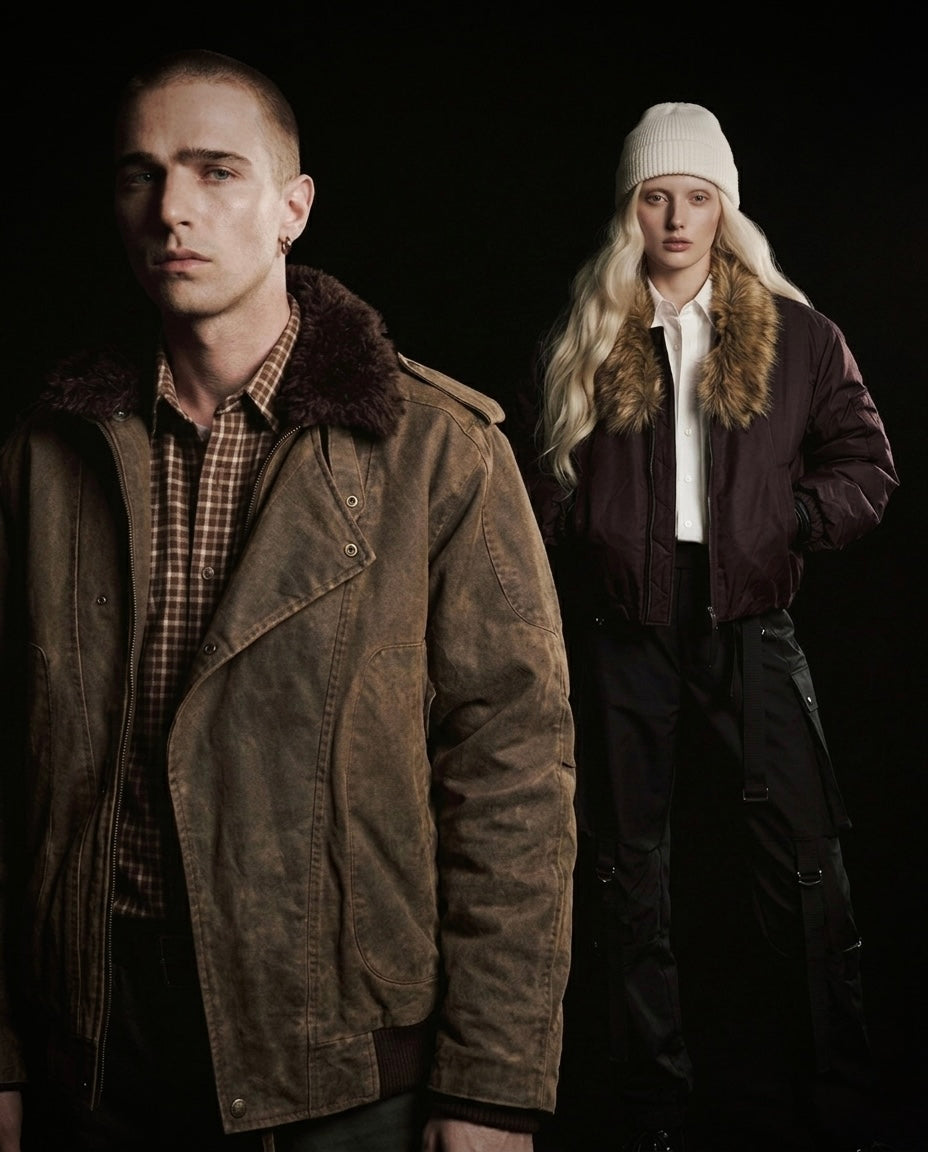
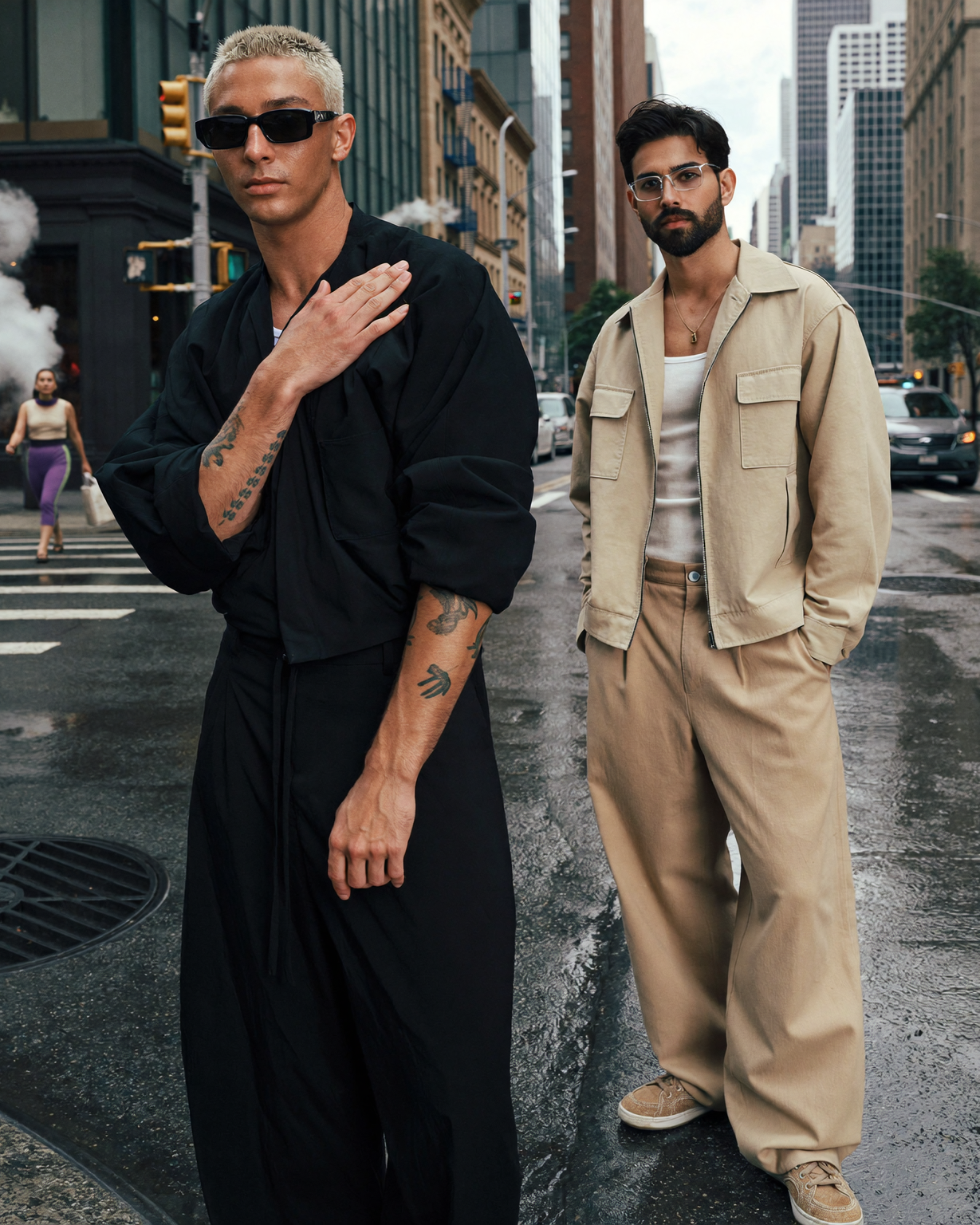

Men's Winter Streetwear With Baggy Jeans and Boots
Winter Is a Question of Proportion
Baggy jeans and boots make a persuasive winter uniform because they solve two different problems at once. The boots bring weight and purpose to the ground; the jeans give the outfit room to move, and often room for the day to change its mind. The difficulty is not finding a jacket that looks dark enough. It is deciding where the volume should sit, how much of the shoe the hem should cover, and whether the layers still make sense once you step indoors and take one of them off.
That is why these five outfits begin with different leading pieces. A short puffer and chunky boots make a compact, weighted silhouette. A long coat and fine knit ask for a cleaner line through the torso. A bomber over a hoodie works with a high-rise, wide leg when the layers do not compete for space. Quilting and cargos bring utility into the equation, while an overshirt and thermal base are the less insulated answer for milder weather or a layered commute. None is a uniform to copy garment for garment. Each is a way to think about length, width, texture, and use.
The practical part is inseparable from the visual one. A wide hem that catches beneath a boot changes the stride as well as the silhouette. An extra layer that fits in theory may bunch at the shoulders when you reach for a train rail. And a jacket that looks substantial is not automatically warm or weatherproof; those are questions for the garment’s actual details, not its mood. Start with the shape you want, test it in motion, and let the outfit earn its place in winter.
Five Ways to Put Jeans and Boots to Work
1. Short black puffer, baggy jeans and chunky boots

A short puffer changes the usual conversation between jacket and jeans. Because its hem stops relatively high, it gives the lower half more territory: the rise of the denim stays legible, and a broad leg can read as a deliberate shape rather than an accumulation of fabric. Chunky boots answer that volume from below. They give the hem something substantial to meet, though there is a limit to the amount of bulk the combination can carry before every part of the outfit seems to be making the same point.
The useful adjustment is in the break. With baggy jeans, a hem that rests cleanly over the boot produces a long, continuous line; a little pooling can make the look more relaxed, but excess fabric tends to hide the footwear and can snag underfoot. Try the jeans with the boots you actually plan to wear, then walk, sit, and take stairs. A mirror sees the outline. Your shoes will tell you whether the outline is workable.
Keep the layer beneath the puffer relatively quiet in length. If it extends too far below the jacket, it can interrupt the clean meeting between the short outer layer and the high volume of the jeans. Wear the puffer open when you want a vertical line through the middle, or close it when the day calls for a simpler block of black above the denim. Neither is a rule; the right choice depends on how the rise and inner layer sit on your body. A shorter jacket can also expose more of the waist when reaching or bending, which is worth testing in cold weather rather than discovering halfway through a walk.
The texture contrast does useful work here. A padded-looking upper layer, denim, and the solid outline of a boot offer variation without needing a bright accent. This is an easy direction for a casual day that may run into evening, especially when the footwear has to cope with a damp pavement. But visual heft is not evidence of insulation or protection. Check the actual jacket and boot details for that, and do not ask a fashion silhouette to perform technical miracles.
2. Long coat, roomy dark jeans and fine knit

A long coat gives the outfit a different kind of authority: it creates a line from shoulder toward the knee, then leaves the roomy dark jeans to widen the base. The fine knit is the mediator. Its comparatively close, uncomplicated presence beneath the coat keeps the torso from becoming a second oversized statement, and gives the eye somewhere calm to land between the long outer layer and the broad denim. The point is not to make the knit tight. It is to avoid so much extra fabric underneath that the coat loses its clean fall or feels restrictive across the shoulders.
Pay attention to where the coat ends in relation to the jeans. A longer outer layer can make wide trousers feel composed, but it can also swallow the proportions if both coat and denim are very generous and the footwear disappears. Boots with a clear, substantial shape help ground the lower edge; a hem that breaks neatly over them preserves the movement of the jeans. If the coat is worn open, the knit and waistband create a visible central line. Closed, it becomes a more continuous column, which can feel sharper but makes fit through the chest and sleeves more important.
This is a useful combination for a gallery afternoon, a music night, or a day that moves between outside and heated rooms. A long coat looks considered on arrival, while a fine knit keeps the outfit from feeling like a stack of protective layers once indoors. The tradeoff is practical: a coat with generous length can be cumbersome on crowded transport, and a fine knit alone may not be enough for a cold wait outside. Treat the knit as one layer in a system, not proof that the outfit is warm.
Dark garments are not automatically harmonious just because their colors are near each other. Washed denim absorbs light differently from a smoother knit or a coat with a more defined surface. That difference gives a monochrome outfit dimension, but it can also make mismatched blacks conspicuous. Compare the pieces in daylight, and let one finish lead rather than trying to make every surface equally noticeable. The roomier the jeans, the more important the hem and boot relationship becomes; the coat supplies length, but it cannot fix denim that drags.
3. Bomber, hoodie and high-rise wide black denim

A bomber over a hoodie is a familiar pairing, but high-rise wide black denim gives it a more deliberate foundation. The rise brings the jeans higher on the body, while the wide leg carries volume down toward the boots. Above it, the bomber supplies a shorter outer shape and the hoodie adds a softer, layered outline around the neck. It is a strong arrangement when the pieces have distinct jobs: jacket for the outer silhouette, hoodie for the middle layer, jeans for the long line.
The danger is crowding. A hood, a bomber collar, and a long hoodie hem can all gather at once, creating bulk at the neck and hips. Choose a hoodie whose body sits comfortably under the jacket and does not extend so far that it breaks the relationship between bomber and rise. That does not mean the hem must vanish; a modest, visible layer can make the combination feel relaxed. The useful test is movement. Reach forward and raise your arms. If the jacket pulls up sharply or the hoodie rides and bunches, the outfit may be better in a different size or with a less substantial middle layer.
The high rise changes how the wide leg reads. It can lengthen the lower line and make the jeans feel intentional beneath the shorter jacket, but only if the waistband sits where the cut was designed to sit. Do not rely on a belt or a forced tuck to manufacture the proportion. Check the actual rise and measurements, and see how the denim behaves when you sit. Wide black jeans can also be a good counterpoint to the softer, more casual shape of a hoodie: the dark field gives the outfit continuity, while differences in surface keep it from becoming a single flat block.
Boots need enough presence to meet the hem without turning the outfit into a contest in heaviness. A broad boot can hold its own beneath the wide leg; a more modest profile may disappear, which is not necessarily wrong, but changes the emphasis. This is a good choice for a cold commute, a casual evening, or any plan where the hoodie is welcome indoors. The bomber is not a guarantee of warmth, and the outfit’s layered appearance should not substitute for checking the weather demands of the day.
4. Quilted jacket, straight cargos and lace-up boots

With straight cargos, the pockets are not background decoration. They add visible structure and width around the thigh, so the jacket should work with that shape rather than pile another strong interruption on top of it. A quilted jacket brings its own pattern and padded outline. The result can feel purposeful and utilitarian, particularly with lace-up boots, but it is more convincing when the jacket’s hem and the cargo pockets do not collide at exactly the same visual point. Try the layers together and notice where the outer edge falls against the pocket placement.
Straight-leg cargos offer a useful alternative to baggy denim. Their line can show more of the boot and make the lower half feel less expansive, while the pockets supply the interest that a very wide jean might provide through sheer volume. That makes them a sensible option when you want the outfit to feel practical rather than oversized. Still, “straight” is not a guarantee of a clean fall. The leg needs to clear the boot shaft without catching, and the hem should neither hover awkwardly nor collapse into a stack of fabric. Lace-up boots often have a visible upper and fastening detail; decide whether you want the trouser to sit over that shape or leave more of it in view.
The jacket sets the tone, but its quilting also adds texture to an outfit already built around pockets, seams, and laces. Keep the rest of the layers measured. A simple base layer leaves the outerwear and cargos room to register, and avoids a pileup of collars and hems. If the day warms, the jacket can come off, so check that the remaining combination still feels intentional rather than like the supporting cast has wandered onstage without its lead.
This is a useful direction for a day with a lot of walking or a schedule that moves between cold streets and warmer interiors. The straight leg gives the boot a clearer job, and the cargo pockets bring a functional note without requiring a baggy cut everywhere. The tradeoff is that pockets add visual and physical bulk. Carrying too much in them can pull the fabric out of line, so use them for what is convenient rather than treating them as portable storage for the contents of a desk drawer. And, as with the other looks, quilted appearance alone says nothing definite about warmth or weather resistance.
5. Dark overshirt, thermal base and relaxed denim

The dark overshirt and thermal base make a quieter proposition than a puffer or quilted jacket. Relaxed denim gives the outfit its breadth, while the overshirt adds a distinct top layer without the more substantial outline of the other outerwear choices. The thermal layer sits close underneath and keeps the stack simple. That is useful on a milder day, during a commute with a lot of time indoors, or when you want an outer layer that can be removed without leaving a complicated outfit behind.
The balance depends on length. An overshirt that finishes near the hip can work neatly with relaxed jeans, but a long base layer extending well below it may make the torso look disconnected from the leg. Try it open first. The two sides frame the thermal and create a vertical line; buttoned or closed, the overshirt becomes a more unified shape, which may suit a cleaner, less layered look. Either way, make sure the shoulder and sleeves allow the thermal beneath without pulling. An overshirt that fits beautifully over a T-shirt may feel quite different over a winter base layer, a discovery best made at home.
Here the denim should do enough to prevent the upper half from feeling too restrained. Relaxed does not have to mean shapeless: look for a leg that hangs comfortably, then decide how much of the boot you want to see. A modest break keeps the footwear in the composition; extra length softens the line but can become cumbersome. Boots give this lighter layering arrangement some weight, though they cannot make an uninsulated overshirt suitable for severe cold. Bring a genuinely warmer layer if the forecast calls for it.
Texture matters because dark-on-dark can flatten when all the surfaces behave alike. A more visibly washed denim against a quieter overshirt and a fine base layer creates contrast without introducing another color. The useful restraint is to make one surface the feature, not to assemble a committee of competing finishes. This is also the most adaptable of the five combinations: the overshirt can work indoors, and the layers are easy to adjust. Its limitation is just as clear. It is a styling approach for conditions it can handle, not a substitute for outerwear with verified insulation and protection.
The Fit Is a Moving Part
It is tempting to judge winter clothes from the waist up because that is where jackets and collars make their first impression. With baggy jeans and boots, the final balance often happens lower down. The boot changes the apparent width of the hem; the hem can cover the boot, stop above it, or gather on it. Each choice alters the leg line and the way the upper layers feel in proportion. A short puffer may make a broad jean look balanced when the footwear has weight. A long coat can make the same jean feel more composed, provided the trouser break remains visible enough to anchor the outfit.
Try the full combination with the intended shoes, not a convenient substitute. A jean that sits cleanly over one boot may catch on another, even if both are described as chunky. Walk at a normal pace, take stairs, and sit down. Check the hem when your knee bends, not only when you stand still. If it pools, ask whether that is the line you actually want and whether you can move safely in it. A small change in trouser length can matter more than adding a chain, bag, or another piece of outerwear. The silhouette is not a static drawing; it has to function from several angles and at several speeds.
The same principle applies above the waist. A hoodie under a bomber can be comfortable until you reach forward. A fine knit under a long coat can look clean until the sleeve catches at the wrist. Wear the layers you expect to use together and move as you would during the day. If the jacket rides up, the coat pulls across the back, or the middle layer twists, the fit needs reconsideration. Do not confuse the ability to close a garment with a good layered fit. Leave enough ease for the layers beneath, while avoiding so much excess that the shoulders and sleeves become a separate problem.
Warmth, texture and the art of not over-layering
Winter dressing is partly a question of managing transitions. The coat that feels necessary on the pavement may become inconvenient on a packed train; the layer you remove indoors should not leave a flimsy or incoherent outfit behind. The long-coat-and-knit combination has a calm inner structure. The bomber-and-hoodie pairing is more casual, but can feel crowded if both pieces demand the same amount of space. The overshirt outfit is easy to adjust, although it has a narrower range in genuinely cold conditions unless warmer outerwear is added.
Names and appearances do not settle the weather question. A puffer, quilted jacket, or overshirt can vary in construction and performance. Check the specific garment’s information for insulation, care, and any stated protection; do not infer those qualities from a dark color, padded outline, or photograph. The same goes for boots. A substantial silhouette may look prepared for winter without necessarily being appropriate for wet or icy conditions. Choose footwear for the ground and weather you will meet, then check that the jeans work with it.
Texture is a practical styling tool because it gives dark clothes definition without requiring a new color. Washed denim against a smoother knit creates a different effect from denim paired with a quilted jacket and cargo pockets. The aim is not to maximize contrast everywhere. If the jeans have a prominent wash, let the upper layers offer some visual quiet. If the outfit is mostly smooth, a textured layer can carry the interest. Notice the way surfaces look in daylight as well as indoors; near-black pieces can appear harmonious in a room and unexpectedly different outside.
Choosing the lead piece
A useful wardrobe decision begins with the day, not with the category name. Reach for the short puffer when you want the jacket to stop high and the jeans to carry the length. Choose the long coat when you want a more continuous outer line and have room to manage its length. A bomber and hoodie suit a casual, layered mood, but both need to fit together in motion. Quilting with straight cargos is the more utility-minded direction. An overshirt works when conditions allow a lighter outer layer or when it will sit beneath something warmer.
The trouser choice shifts the character just as much. Baggy jeans make volume an obvious part of the outfit; relaxed denim gives it room without necessarily making it the headline. Straight cargos show more of the boot and introduce pocket structure. High-rise wide black denim creates a strong line from waist to shoe, but only if the rise is comfortable and the hem is considered. There is no prize for wearing the widest cut available. The right amount is the amount you can wear, move in, and still recognize yourself in.
Before buying, compare actual measurements with a pair you already like. Look at the rise, leg width, and inseam, then consider where the hem will land over your boots. For outerwear, check the shoulder and sleeve measurements with your intended middle layer in mind. Product photos can help you understand a garment’s styling, but they cannot promise that its proportions will translate unchanged to another body. For a related denim direction, compare the COLDHEART studded wide-leg jeans with the styling principles here, checking its own materials, fit, and measurements rather than assuming it duplicates one of these photographed outfits.
Questions Before You Leave the House
How baggy should the jeans be with winter boots?
There is no single useful width without considering the rise, hem, and boot together. A broad leg needs enough room to fall over the footwear without catching, while a straight or relaxed cut may show more of the boot. Try the jeans with the actual pair you plan to wear. If the hem drags or gathers awkwardly, consider a different length or cut rather than relying on the boot to disguise it. The goal is a clean, comfortable break, not a measurement taken in isolation.
Can I wear boots other than chunky styles?
Yes. Chunky boots make an easy visual counterweight to wide denim, but a more streamlined boot can work if you prefer a lighter lower line. The difference is one of emphasis: a smaller profile may sit quietly beneath a broad hem, while a substantial one remains visible. Straight cargos are especially useful when you want to show more of the footwear. Think about the weather and walking conditions as well as the outfit, and choose a boot that is comfortable and appropriate for both.
Are these outfits warm enough for winter?
Not automatically. The combinations describe silhouettes and layers, not a guaranteed level of insulation. An overshirt and thermal base may suit a milder day or work beneath warmer outerwear, while a puffer or long coat may offer more coverage depending on its actual construction. Check the garment’s stated details and dress for your local conditions. If you will be outside for a long time, account for the temperature, wind, and precipitation rather than assuming a thick-looking jacket is sufficient.
What should I check when layering a hoodie under a bomber?
Check the shoulder, sleeve, and body length with both garments on. The hoodie should not make the bomber pull when you reach, and its hem should not overwhelm the high-rise jeans or gather heavily around the hips. A visible edge can look intentional; a bulky stack that shifts every time you move is less useful. Try the outfit while standing, sitting, and reaching before deciding that the combination fits.
How do I keep dark layers from looking flat?
Use differences in surface and shape rather than adding contrast for its own sake. Washed denim, knitwear, quilting, and a smoother outer layer can each catch light differently. Choose one or two surfaces to provide interest, and let the remaining pieces support them. Check the outfit in daylight, where near-black shades and finishes can appear more distinct than they do indoors. A strong silhouette does not need every garment to compete for attention.
Build the Outfit Around the Day
These looks are most useful as ways to read proportion, not as prescriptions. Start with the outer layer your day requires, settle the trouser length against the boots, then adjust the middle layer until the outfit works both open and closed. For more ideas about how different cuts behave, see our trouser and denim guide and the streetwear silhouette guide. You can also Shop OFFCULTURE® streetwear or browse compatible separates, comparing each garment on its own terms rather than expecting an editorial combination to be sold as a matching set.
The winter outfit worth repeating is not necessarily the most dramatic one. It is the one that moves comfortably, meets the weather honestly, and still makes sense after the coat comes off. Boots keep the ground in view. Baggy jeans give the silhouette room. The rest is a matter of knowing when to add weight, and when the outfit has said enough.
Read more

Five distinct ways into dark streetwear outfits for men with layered jackets, including boxy black bomber, layered tee and straight cargos and cropped dark jacket, longline shirt and wide trousers....

The blazer leaves office styling behind in five pairings: vintage tee and faded jeans; a cropped jacket with wide trousers and low sneakers; an oversized cut with a tank and cargos; a hoodie beneat...