

Dark Streetwear Outfits for Men With Layered Jackets
Darkness, With Room to Move
Black is often treated as a shortcut: choose dark clothes, add a jacket, and call the problem solved. The better outfits in this territory are less automatic. They depend on a conversation between lengths and volumes: a short jacket against a long shirt, a compact hood beneath an overshirt, a wide trouser leg that arrives at the shoe without swallowing it. Darkness is the setting, not the styling plan.
Layering makes those relationships visible. A hem becomes a line; a collar becomes a decision; the gap between jacket and waistband starts to matter. Even texture can do useful work without a change of colour. Washed denim, a smooth-looking shirt, a ribbed neckline or the visual weight of cargo pockets each asks the eye to pause somewhere different. The result needn’t be complicated, but it should look considered from the shoes upward as well as from the jacket down.
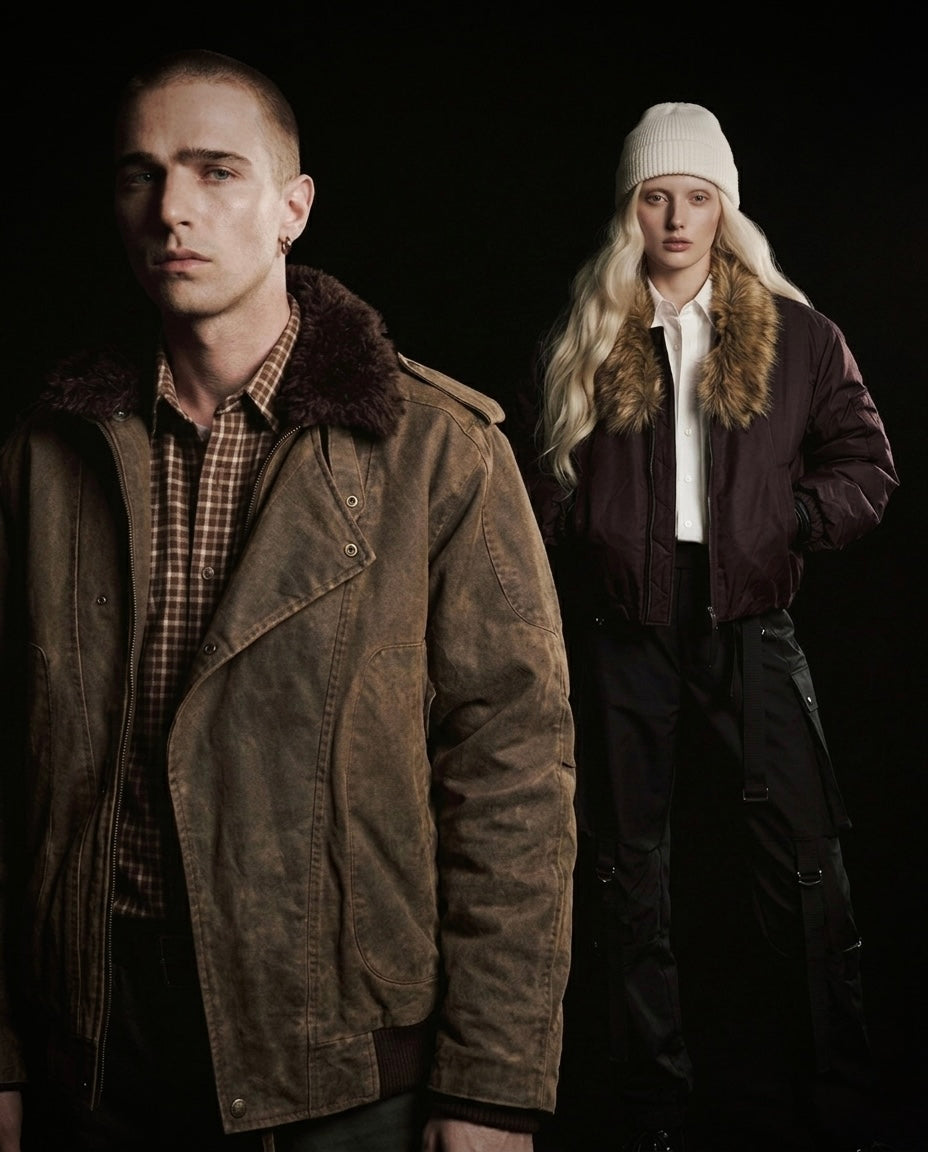
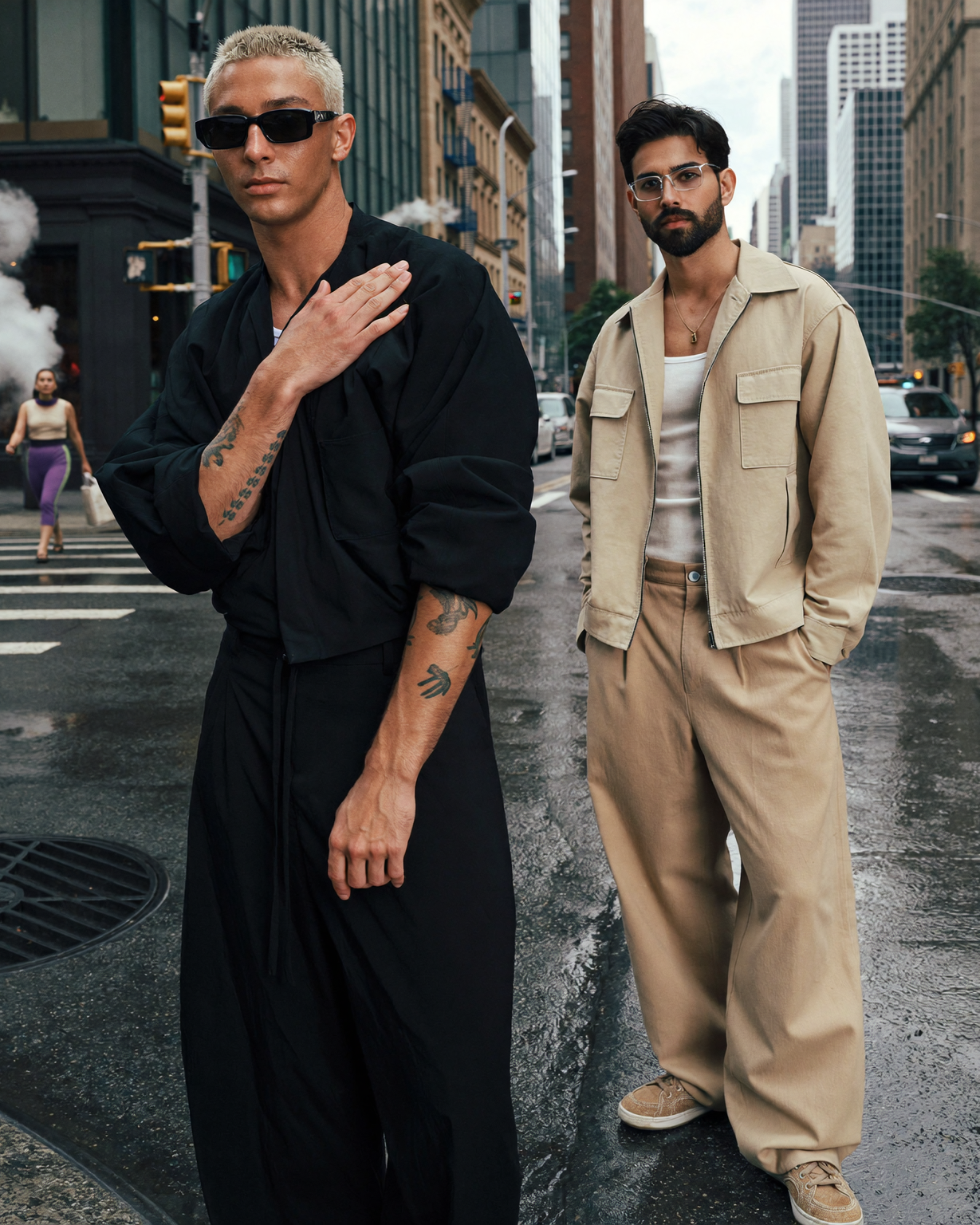
The five photographed outfits here approach the question through distinct proportions rather than a single uniform. A boxy bomber and straight cargos make a case for controlled width. An overshirt and compact hoodie rely on containment. Cropped outerwear changes the role of a long shirt, while a coat over a short zip jacket turns layering into a study in vertical line. The last combination uses a rollneck and cargo boots to bring utility and restraint into the same frame.
These are styling ideas, not ready-made uniforms or claims that each exact combination is sold together. Their value is practical: they show what to watch when choosing pieces, getting dressed, and then, crucially, moving around in them. A photograph can make a layered outfit look effortless. The wearer still has to sit down.
A bomber, a tee, and the useful discipline of straight cargos

A boxy black bomber, layered tee and straight cargos begin with a clear division of labour. The jacket establishes the broad shape; the shirt layers introduce a second hem; the cargos carry that upper-body volume into the lower half without requiring a dramatically wide leg. It is a grounded silhouette, but not necessarily a heavy one. Straight trousers leave room for movement while keeping the outline more direct than a loose, sweeping cut.
The bomber’s boxy proportion is the point, so sizing up indiscriminately can blur it. A little room through the body gives the jacket its intended shape; too much extra length or width can make the whole outfit read as a single block. Consider where its hem lands in relation to the tee layers and cargo pockets. If all three features crowd around the same area, the torso can look busy and the pockets can make the hips seem broader than intended. A visible tee hem works best when it reads as a deliberate line rather than an accidental glimpse.
Cargos already bring detail and visual weight to the thighs. That makes the upper layers worth keeping legible: the jacket can be the main statement, with the tees offering quiet depth rather than a competing focal point. A straighter leg also helps distribute the effect of the pockets. If the trousers taper sharply, those pockets can become the outfit’s widest and most prominent feature; if they are too roomy, the silhouette may lose the clarity that makes the bomber-and-cargo pairing appealing. Neither outcome is a moral failing, but both should be chosen rather than discovered in a changing-room mirror.
Footwear decides how the straight leg finishes. A more compact shoe can make the trouser line feel clean and show more of the footwear; a chunkier shoe gives the hem a firmer endpoint, provided the fabric doesn’t bunch heavily over it. Think about the occasion, too. This is a natural choice for casual city days, travel, or anywhere pockets and easy movement make sense. For an indoor evening or a sharper setting, simplifying the cargo detail elsewhere may help, if the trousers allow it. The useful lesson is not to make everything neat. It is to give the outfit one strong shape and enough space around it to breathe.
The overshirt’s quiet argument with the hoodie

The black overshirt, compact hoodie and washed jeans are built on a smaller negotiation: how to keep three familiar pieces from becoming a heap of collars, cuffs and hems. The answer lies in the word compact. A hoodie that sits close enough beneath the overshirt to let both layers retain their shape gives the combination a clear center. A bulky hood or an overly long sweatshirt can push the overshirt out of place and gather extra fabric around the neck and waist.
The overshirt is less formal than a coat, but it still needs a clean relationship with what sits beneath it. Wear it open and the hoodie becomes a visible frame; wear it closed and the collar and hood need to coexist without fighting for the same patch of space. Either can work. The better choice depends on the weather, the room you are going into, and whether the outfit should feel more relaxed or more contained. The important test is that the middle layer remains useful if the overshirt comes off. A hoodie that only works when hidden is a questionable travel companion.
Washed jeans lend the outfit a different kind of emphasis. Their lighter, worn-looking surface can lift an otherwise dark combination without relying on a bright colour. That contrast is already doing visual work, so there is no need to add a loud graphic or pile on accessories merely to prove the outfit has personality. The jeans’ cut matters as much as the wash: a straighter leg supports the overshirt’s direct shape, while a looser cut makes the lower half more relaxed and changes where the eye settles.
Footwear can sharpen or soften that impression. A streamlined shoe leaves the denim as the main break in the silhouette; a more substantial shoe suits a looser jean, particularly if the hem falls over it without dragging. For an everyday commute or a casual meeting, the overshirt has the useful advantage of being an easy layer to remove. But check the outfit in both states. The hoodie and jeans should still look like a pairing when the outer layer is over a chair, not like the leftovers from a more interesting outfit.
A cropped jacket makes the long shirt count

A cropped dark jacket, longline shirt and wide trousers rearrange the usual hierarchy. The jacket ends earlier, the shirt continues below it, and the trousers bring their own generous width. Rather than hiding the length of the shirt, this look puts it to work as a visible vertical line. The effect can feel deliberate and modern, though it asks for a little more attention than the forgiving bomber-and-cargo combination.
The key is the meeting point between jacket and shirt. A visible shirttail should read as part of the silhouette, not as a shirt that happens to be too long. The cropped jacket gives that extra length somewhere to show; the shirt, in turn, makes the jacket’s shorter hem feel intentional. If both pieces are very loose, their edges can drift without giving the outfit a clear center. If the shirt is too close-fitting for the volume of the trousers and jacket, it may look disconnected. Try the layers together, then move: lift your arms, reach forward, and sit. A hem that looks artfully placed while standing may migrate once the day starts.
Wide trousers are not a supporting detail here. They are a second major proportion, and their relationship to the footwear determines whether the whole outfit feels balanced or overfull. A clean break at the shoe lets the width look chosen. Too much pooling can obscure the footwear and make the lower half appear heavier than the jacket above it. A slightly shorter hem brings more attention to the shoe and gives the leg a sharper finish. The right choice depends on the trouser’s cut and your preferred amount of movement, not on a universal rule about how much fabric should meet the floor.
This combination is especially useful when a familiar jacket feels too conventional with a standard-length top. It offers shape through length rather than decoration. For a casual creative setting, the contrast between the short outer layer and long shirt can carry the outfit on its own. In more restrained surroundings, a cleaner shirt and less dramatic trouser width can make the same idea quieter. Shoes should be chosen with the trousers already in mind; a bulky style can reinforce their volume, while a sleeker one provides a little visual relief. The outfit has enough going on in its proportions. It does not need a committee of accessories.
The long coat and the shorter layer beneath it

A long black coat, short zip jacket and pleated pants make layering unusually explicit: one outer line stretches downward while the shorter layer beneath interrupts it. Pleated trousers add movement and definition around the waist, giving the composition a more considered base than a simple long-over-long stack. The attraction is partly the contrast. The risk is that two jackets can compete for space, especially if both bring substantial volume through the shoulders, body or sleeves.
Start with the shorter jacket as the layer that must fit comfortably closest to the body. The long coat then needs enough room to pass over it without pulling, bunching or turning the arms into a private weather system. This cannot be judged by looking at the coat on a hanger. Try the full combination, close or adjust the layers as you normally would, then reach, sit and walk. If the sleeves snag or the coat swings awkwardly over the jacket underneath, the outfit’s dramatic vertical line will be a tax you pay all day.
The pleated pants are a thoughtful counterweight to the layered top. Their shape gives the outfit a sense of structure at the waist, but that structure deserves to be seen. A top layer that hangs too low can cover the waistband and flatten the effect; an inner zip jacket that stops around the waist can preserve it. The coat still supplies length, so a little room in the trousers can balance the upper-body layering without making every element oversized. The distinction is subtle but important: volume is most effective when it has somewhere to stop.
Footwear helps decide how formal or utilitarian the combination feels. A more streamlined shoe lets the long coat and pleats do the talking; a heavier shoe brings the outfit closer to streetwear, particularly if the trouser hem meets it cleanly. Avoid making that decision from the waist up. Pleats, coat length and shoe proportion have to be read together, and the best hem may be different depending on what sits below it. This is a strong option for colder days when a coat is genuinely useful and for occasions where the long outer line feels right. It is less persuasive if the layers are worn only for effect and become uncomfortable indoors. Good styling should survive the coat check.
Washed outerwear, a rollneck, and boots with purpose

The washed jacket, black rollneck and cargo boots bring the outfit’s focus closer to the face and feet. The rollneck gives the neckline a firm, uncomplicated shape; the jacket adds surface variation; the boots anchor the lower half. It is a direct combination, but direct does not mean dull. The interest comes from the difference between a dark, close neckline and the jacket’s visibly washed appearance, rather than from adding more colours or extra layers.
A rollneck can make an outfit feel resolved, particularly when the jacket is left open or sits without a bulky scarf around it. That clean center is worth protecting. If the temperature calls for additional neckwear, comfort wins, naturally, but on a mild day there is little reason to crowd the collar with another statement. Pay attention to the fit through the neck and shoulders: a high neckline that feels restrictive will make the wearer’s whole posture look guarded. A layer is not a success if its best feature is that nobody can see you tugging at it.
The washed jacket supplies contrast without demanding that everything else become brighter. Because the rollneck is plain in description and the boots have practical visual weight, the jacket can carry most of the surface interest. That is a useful way to approach dark clothing generally. Contrast need not mean colour contrast. It can come from the difference between a washed-looking finish and a smoother one, from the edge of a cuff, or from the way a jacket hem sits above the trouser. Such distinctions are quiet, but they are also what stop a dark outfit from turning into one large, undifferentiated shape.
Cargo boots should feel like a considered endpoint, not an unrelated flourish. A straight or roomy trouser can meet them with more ease than a very narrow leg, which may sharpen the contrast between the shoe and the rest of the silhouette. Check the hem while standing and walking. Fabric that catches heavily on the boot can obscure both shapes; a cleaner break lets each retain its outline. This outfit suits casual days when sturdier footwear feels practical and when the jacket’s worn-in visual character belongs in the setting. For a more polished room, a less conspicuous shoe may make the same rollneck-and-jacket idea easier to adapt. The look is strongest when the boots feel useful, not merely photographed.
The small decisions that keep layers convincing
Begin with the layer that sets the shape
There is a temptation to start with the most conspicuous item, usually the jacket, and allow every other choice to follow. That is sensible only if the jacket’s role is clear. The bomber in the first look establishes width; the cropped jacket in the third creates a shortened upper line; the long coat in the fourth changes the entire vertical read. Once that job is identified, the remaining layers can either support it or introduce a deliberate counterpoint.
A useful fitting-room exercise is to try the middle layer with and without the outer one. The compact hoodie should make sense under the overshirt, but it should also work when the overshirt comes off. The longline shirt should look purposeful below the cropped jacket, not merely rescued by it. This is one way to spot a layer that is doing too much concealment. If removing it leaves an unrelated outfit, rethink the proportions before buying another piece to solve the problem.
Length is often more informative than a nominal size label. Compare where a jacket ends against the waistband, pockets and hem of the layer beneath. Then assess sleeve length and shoulder comfort. A garment can have the right body shape and still frustrate you when reaching for a bag or raising your arms. Fit is dimensional, and a photo is a stationary witness.
Balance texture and visual weight
All-black dressing does not require every piece to look identical. In fact, matching every surface too closely can make layers disappear into one another. Washed denim or a washed jacket introduces a different visual register from a plain black rollneck or overshirt. Cargo pockets create detail through shape rather than colour. A tee hem or shirt tail supplies another edge. These distinctions allow an outfit to stay dark without becoming visually mute.
The trick is to decide which difference deserves attention. If the denim is strongly washed, let it remain a focal point rather than competing with several other noticeable features. If the cargos have prominent pocket shapes, a clean upper layer can give them room. If the long shirt is the defining line beneath a cropped jacket, keep the rest of the outfit from adding so many competing hems that the idea gets lost. This is not a plea for minimalism. It is a plea for hierarchy, an underappreciated virtue in clothing and committee meetings alike.
Visual weight matters at the feet, too. Straight cargos and cargo boots both have utility character; together they can feel coherent, but the trouser hem needs to meet the boot without swallowing it. Wide trousers can carry a substantial shoe, though a less bulky shoe may create a more deliberate contrast. There is no single correct pairing. The question is whether the footwear looks like it belongs to the silhouette you built above it.
Dress for the room and the weather you actually have
Layering is practical only when it remains manageable. An overshirt over a hoodie is easy to adjust when moving between outdoors and a heated room, but only if the inner layers remain comfortable once the overshirt comes off. A long coat over a short jacket can make sense in colder weather, but the sleeve and shoulder space must work. A rollneck can simplify the neck area, yet a close neckline may not suit every temperature or preference.
Do not infer warmth, insulation or weather resistance from colour, thickness in a photograph, or a garment’s visual finish. Check product information and decide based on the conditions you expect to face. This is especially important with layered outerwear, because adding garments can create bulk without guaranteeing comfort. The best test is mundane and therefore reliable: wear the full combination, sit down, take a few steps, and check whether you can remove a layer without leaving the outfit stranded.
Occasion changes the balance, too. Cargos and boots may be useful for a day with a lot of walking; a long coat and pleated pants can feel more composed for an evening or a setting where a longer line suits the room. The same outfit can shift by changing the shoe or removing an outer layer, but not every combination has to serve every purpose. A wardrobe becomes more useful when its pieces can move between contexts, not when each look is asked to impersonate a universal uniform.
Shop the relationship, not the imaginary set
When comparing pieces, begin with fit notes, garment measurements and product photographs rather than relying on a category name. “Oversized,” “cropped” and “straight” describe broad intentions, not a guarantee about where a hem will land on your body. Compare the jacket’s length with the shirt or hoodie you plan to wear under it, and consider the trouser’s break with the shoes already in your wardrobe. That is more useful than imagining a perfectly coordinated set that may not exist.
For one point of comparison, the NVRHOME oversized faux-leather jacket offers a way to consider an oversized outerwear silhouette. Check its actual product details, fit and care information rather than assuming it behaves like any other jacket with a similar name. The point is to assess the garment on its own terms, then decide whether its proportions work with pieces you own.
You can Shop OFFCULTURE® jackets and browse compatible separates while keeping that same practical question in view: what will this jacket sit over, and where will those trousers meet your shoes? These links are places to compare individual pieces, not a promise that any photographed outfit is available as an identical set. For more context on outerwear, read our jacket guide; for the larger question of proportion, the streetwear silhouette guide offers another useful way to think about shape, season and essential pieces.
Questions from the changing room
How do you keep a dark layered outfit from looking flat?
Give the eye a few distinct surfaces or edges to read. A washed jean against a black overshirt, a shirt tail below a cropped jacket, or cargo pockets beneath a plain upper layer can provide contrast without introducing brighter colour. Choose one or two such details as the outfit’s focus. If every piece has a strong finish, prominent pocket or competing hem, the result can look busy rather than textured.
What trousers work best with a layered jacket?
Start with the jacket’s length and volume. Straight cargos pair naturally with the boxy bomber because they carry some width without turning the outfit into a single oversized shape. Wide trousers make sense with a cropped jacket when the shirt tail provides a clear link between the two lengths. Pleated pants can balance a long coat, while washed jeans keep an overshirt-and-hoodie combination relaxed. In every case, try the intended shoes and check the hem in motion.
Can these combinations work for different occasions?
Yes, with an honest look at the room and the work the outfit has to do. The overshirt, hoodie and jeans are adaptable because the outer layer can come off; the coat combination is useful when the long outer layer makes sense for the weather and setting. Cargos and cargo boots lean practical, while cleaner footwear or simpler trousers can make a layered look feel less utilitarian. Comfort is not a styling failure. If a combination restricts you, it is the combination that needs adjusting.
Should every layer be oversized for a streetwear silhouette?
No. A single generous piece can establish the character of an outfit more clearly than several competing oversized layers. The compact hoodie under the overshirt and the short zip jacket beneath the long coat both show the value of containment. Fit the layer closest to the body for movement, then make room for the outer garment. The aim is a deliberate relationship between pieces, not a sizing exercise conducted with the lights off.
The photograph ends; the day does not
Each of these five looks depends on a different proportion, but the useful test is the same: does the outfit still make sense when you move, remove a layer, or meet a different kind of room? Begin with the shape you want, check the hems from shoulder to shoe, and let texture do more than colour when the palette stays dark. The most convincing layers are not the ones that demand attention at every edge. They are the ones you can live in after the photograph has been taken.
Read more

A blazer looks different when the trousers stop behaving like office clothes. The guide puts relaxed charcoal blazer, tee, baggy jeans and boots beside cropped blazer, high-rise jeans and minimal s...

When the trousers carry the volume, the top half needs a point of view. From short black puffer, baggy jeans and chunky boots to dark overshirt, thermal base and relaxed denim, this five-look guide...